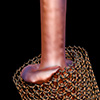
Real-time microscopy and AI reveal how atomic wetting controls tin oxide nanowire growth inside carbon nanotubes, uncovering the mechanisms that link temperature, geometry, and surface chemistry.
(Nanowerk Spotlight) Liquids behave strangely when confined to spaces only a few atoms wide. They can climb, spread, or retreat depending on forces at the interface between liquid, vapor, and solid. These behaviors—collectively known as wetting—govern many nanoscale processes, from coating to catalysis, and play a decisive role in nanofabrication, where some materials are built atom by atom within narrow channels.
In this confined world, a vapor may transform into a liquid that fills a nanotube and solidifies into a nanowire, yet the exact sequence that makes this possible has remained unclear. Traditional equations for capillary rise explain how water moves through glass tubes but fail inside a carbon nanotube, where extreme curvature and atomic-scale forces dominate. At that scale, temperature and surface energy determine whether a liquid front appears at all.
Until recently, scientists could capture only static images at ambient temperature before and after such transformations, missing the moment when a vapor first condenses and spreads. This inability to observe wetting directly has limited progress toward controlling nanowire formation. Advances in high-speed transmission electron microscopy and machine learning now make it possible to record atomic motion in real time, revealing the elusive dynamics that decide whether confined liquids wet or withdraw from a surface.
TEM micrograph of a metallic Sn nanowire encapsulated within the centre of the a MWCNT core (left), and a graphical depiction of the liquid-growth mechanism underlying the nanowire formation (right). (Image: Courtesy of the researchers)
A new study (Nature Communications, “Capturing atomic wetting dynamics in real time”) applies these techniques to tin oxide vapor inside multi-wall carbon nanotubes. Using atomic-resolution transmission electron microscopy (TEM) combined with a neural network that classifies material phases, the researchers follow how vapor condenses, wets the inner wall, and evolves into a confined nanowire.
This work connects wetting behavior to measurable outcomes such as nanowire length, diameter, and growth rate, offering a data-driven framework for understanding confined liquid dynamics.
“The experimental program began five years ago, but the decisive progress came when specialists in artificial intelligence joined the effort,” explains Professor Nicole Grobert, who led the work. “The collaboration between experimental scientists and AI experts grew directly from my policy work as Chair of the Group of Chief Scientific Advisors and Lead Author of the Scientific Opinion on Artificial Intelligence for Research for the European Commission, alongside Professor Anna Fabijańska’s role leading the Commission’s Scientific Evidence Report on AI.”
“These overlapping scientific and policy roles created a bridge between researchers and policymakers that ultimately made this breakthrough possible,” she adds. “It stands as an example of how science-for-policy and policy-for-science can reinforce each other—policymakers convening scientists, and scientists supplying evidence to guide policy—within the ecosystem that underpins Europe’s newly published AI Strategy.”
The scientists conducted experiments where carbon nanotubes serve as narrow hosts for tin oxide vapor. As the temperature rises, the vapor enters the open tube ends and condenses into liquid droplets that adhere to the inner walls. These droplets merge and extend, forming a continuous nanowire that later converts to metallic tin when exposed to hydrogen.
Schematic illustration of the vapor-phase formation of metallic nanowires confined within the core of the MWCNT. (Image: Courtesy of the researchers)
“Wetting controls everyday phenomena, from how water moves through natural capillaries to how liquids spread on surfaces, and governs how nanowires form inside the core of MWCNTs,” said George Tebbutt, the paper’s first author. “Seeing wetting happen atom by atom in real time changes how we understand and fabricate these advanced materials. This was only possible using in situ atomic-resolution TEM, which can track individual atoms as they move.”
The entire sequence unfolds under the microscope as the sample heats from ambient temperature to about 1,100 °C. A fast detector captures more than a thousand frames per second, producing a record of every stage of transformation.
To handle this enormous volume of data, the team trained a convolutional neural network to recognize distinct regions within the images: empty cores, nanotube walls, amorphous tin oxide, liquid tin oxide, intermediate oxides, and metallic tin. The model achieved over 97 percent accuracy, allowing each frame to be segmented automatically and the evolution of phases tracked quantitatively. This automation made it possible to focus on the physics behind what the microscope revealed.
The recorded sequence shows three distinct stages. First, amorphous tin oxide forms as a disordered solid. Second, it melts into a liquid that wets the wall and advances as a curved front. Third, continued heating causes the liquid to vaporize and retreat.
The change from solid to liquid marks the start of strong spreading along the wall. Wetting begins not as a uniform coating but as separate droplets that nucleate at specific points once they overcome an energy barrier. This finding challenges earlier assumptions that condensation begins with a thin adsorbed film and shows instead that nucleation governs the onset of filling.
A central measurement in the study is the contact angle, the angle between the liquid surface and the solid wall. Smaller angles, below 90 degrees, indicate good wetting; larger ones mean poor adhesion. For tin oxide, the contact angle decreases with temperature, dropping below 90 degrees above roughly 600 °C. The liquid then spreads readily along the nanotube interior. For metallic tin, the contact angle remains high throughout heating, showing that it does not wet the surface. Tin oxide’s stronger attraction to the carbon wall arises from its polar nature, while metallic tin retains stronger internal cohesion. This difference explains why only the oxide phase fills and advances to form a wire.
By tracking hundreds of nanotubes, Grobert’s team finds that geometry strongly influences growth. Smaller tubes fill first because their curvature lowers the nucleation barrier. Larger ones require higher local vapor pressure but grow faster once condensation begins. Measured growth rates average 2.3 nanometers per hour in length and 0.78 nanometers per hour in diameter, with an aspect ratio increase of 0.11 per hour. The filled volume scales with diameter to the power of 2.5, and the proportionality constant rises with heating time, showing that condensation remains active during growth.
The process follows two distinct stages. In the nucleation stage, a liquid droplet first forms and wets the wall once the contact angle falls below 90 degrees. In the elongation stage, capillary forces drive the liquid forward while viscous drag resists motion. After nucleation, growth becomes capillary-controlled rather than limited by vapor supply, and the meniscus position increases with the square root of time; this is consistent with viscous flow dynamics under confinement.
The researchers also observe variation from nanotube to nanotube. Local defects such as atomic vacancies or step edges on the carbon wall alter adhesion and shift contact angles by tens of degrees. These irregularities determine where droplets form and where growth stops, suggesting that surface perfection directly affects reproducibility. Improving wall quality could therefore yield more uniform wire lengths and better-controlled growth sites.
From these results, practical rules for confined synthesis emerge. The vapor precursor must form a wetting liquid at the chosen temperature. Tube ends should be clean and open to encourage condensation. Diameter distribution sets both nucleation order and final wire dimensions. Once filling starts, the outcome depends mainly on the balance between capillary pull and viscous resistance. Adjusting these factors allows predictable control over structure and length.
“We were able to conclude that atomic-scale wetting dictates whether vapor can transform into a confined nanowire,” Grobert notes. “By watching this process directly, we identify how contact angle and condensation rate determine growth.”
The team’s combined microscopy and machine-learning framework can be extended to other materials and host structures, enabling a more systematic design of nanoscale fabrication processes. The collaboration behind this work also shows how policy engagement can catalyze scientific innovation. When decision-makers foster links between disciplines and researchers apply those insights in the lab, progress accelerates in both domains. Such exchanges may become increasingly important as artificial intelligence reshapes how science itself is done.
For authors and communications departmentsclick to open
Lay summary
Prefilled posts
Nanowerk Newsletter
Get our Nanotechnology Spotlight updates to your inbox!
Thank you!
You have successfully joined our subscriber list.
Become a Spotlight guest author! Join our large and growing group of guest contributors. Have you just published a scientific paper or have other exciting developments to share with the nanotechnology community? Here is how to publish on nanowerk.com.