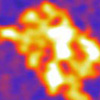
Atomic force microscopy reveals three distinct dynamic states in individual polymer chain segments on surfaces, challenging the assumption of uniform equilibrium behavior.
(Nanowerk News) Researchers at Kyushu University have for the first time directly observed how individual segments of polymer chains behave when confined to solid surfaces. The study, published in the Journal of the American Chemical Society (“Direct visualization of segment-like dynamics in isolated polymer chains on solid surfaces”), used atomic force microscopy to track nanometer-scale motion along isolated polymer molecules. The results expose a previously unknown pattern of behavior in which molecular segments repeatedly attach to and detach from the surface, a finding that could inform the development of stronger and more durable adhesives.
Key Findings
Three distinct segment states were identified within a single polymer chain adsorbed on a surface: thermally activated, thermally suppressed, and a switching state that alternates between the two.
The switching behavior represents non-equilibrium dynamics, overturning the conventional assumption that interfacial polymer chains move uniformly.
Atomic force microscopy achieved spatial resolution of approximately 0.4 nanometers laterally and below 0.1 nanometers vertically, with time resolution between 0.3 and 26 seconds.
Transportation accounts for roughly 30% of global energy consumption. One approach to reducing that figure involves making vehicles lighter by bonding dissimilar materials, such as metals and plastics, into single structures. Achieving reliable bonds between unlike materials remains an engineering difficulty, and adhesives are central to the solution.
Adhesive performance depends on what happens at the interface, a nanometer-thin region where polymer molecules contact the solid surface. Researchers have long understood that the structure and thermal mobility of polymer chains influence how well an adhesive grips a surface. But that understanding has relied on measurements averaged across large numbers of molecules. How individual chains and their segments actually move at the interface had not been observed.
A team led by Distinguished Professor Keiji Tanaka of Kyushu University’s Faculty of Engineering set out to fill that gap. They turned to atomic force microscopy, a technique that maps surfaces at atomic resolution by scanning a fine probe tip across a sample while maintaining extremely small contact forces.
“We sought to establish a more realistic molecular picture of adhesive interfaces,” says Tanaka. “Our recent studies have shown that the way polymer chains behave on the adherend surface strongly affects adhesion performance. By observing this motion, we can better understand the underlying mechanisms.”
Polymer chains, like all molecules, are in constant motion driven by thermal energy. Theoretical models such as the fluctuation-dissipation theorem describe this thermally driven motion mathematically, but directly watching it happen at the scale of a single molecule has remained out of reach. The measurement demands are severe: chain height must be tracked at atomic precision, continuously, over long periods, with time resolution under 100 seconds, and without damaging the delicate sample.
Using atomic force microscopy, the researchers measured nanometric changes in height along different segments of a single polymer molecule. Through careful mathematical processing of these measurements, they found that individual segments can be in three distinct states, deepening our understanding of how polymer-based adhesives attach to surfaces at the single-molecule level. (Image: Kyushu University)
The team’s atomic force microscopy setup met these requirements. While the technique had previously been used to image the shape of polymer molecules, the researchers extended it by collecting time-resolved images and applying time-series analysis to extract relaxation times. This turned the microscope into a tool capable of quantifying molecular dynamics rather than merely capturing static snapshots. The system achieved lateral spatial resolution of roughly 0.4 nanometers, vertical resolution below 0.1 nanometers, and temporal resolution between 0.3 and 26 seconds. By imaging the same chain at different temperatures, the team also assessed how each segment’s motion responded to heating.
The data revealed that a single polymer chain adsorbed on a surface contains three distinct types of segments existing simultaneously. Some segments were thermally activated, meaning they moved more as temperature increased. Others were thermally suppressed, temporarily locked in place by adsorption, the weak attachment of the molecule to the surface. A third category of segments switched randomly between activated and suppressed states, exhibiting what physicists call non-equilibrium behavior. In a system at equilibrium, dynamics are stable and balanced. The observed switching indicated ongoing fluctuating processes that do not settle into a single steady state.
“Our findings provide the first real-space, molecular-level evidence, overturning the conventional view that interfacial polymer chains exhibit uniform, equilibrium dynamics,” remarks Tanaka.
The team plans next to study how these dynamics change when multiple polymer chains overlap and interact, conditions that more closely resemble actual adhesive systems. Such experiments could yield a general framework connecting the structure, dynamics, and function of polymers confined at interfaces. Potential applications span adhesives, coatings, and composite interfaces.
“We expect the insights uncovered to advance molecular design principles for adhesives, and to contribute significantly to the performance enhancement and lightweighting of materials, including those used in next-generation automobiles and transportation systems,” says Tanaka.