| Mar 04, 2026 |
Researchers propose a universal asymmetric spin torque mechanism that deterministically switches the Neel vector in collinear antiferromagnets for ultrafast memory.
(Nanowerk News) Researchers have demonstrated a universal mechanism for electrically controlling collinear antiferromagnets, addressing one of the central obstacles in antiferromagnetic spintronics. A team led by Prof. Shao Dingfu at the Hefei Institutes of Physical Science, Chinese Academy of Sciences, developed a theoretical framework showing that asymmetric spin torque at thin-film interfaces can reliably flip the Néel vector, the magnetic order parameter that encodes data in antiferromagnetic materials.
|
|
The findings were published in Physical Review Letters (“Deterministic Switching of the Néel Vector by Asymmetric Spin Torque”).
|
Key Findings
- Broken interfacial symmetry in thin-film antiferromagnets causes unequal spin absorption between magnetic sublattices, producing an asymmetric spin torque that deterministically switches the Néel vector.
- The mechanism applies universally to all collinear antiferromagnets, removing the requirement for materials with rare crystal symmetries.
- Antiferromagnetic Néel vectors remain stable under magnetic fields up to ten times the anisotropy field, consistent with experimental observations in Cr₂O₃ at 3 tesla.
|
|
Antiferromagnetic materials have attracted intense interest for next-generation data storage because their fully compensated magnetic order eliminates stray fields and permits operation at terahertz frequencies. Yet that same compensated structure creates a fundamental control problem.
|
|
The Néel vector, which defines the orientation of alternating magnetic moments and serves as the information-carrying quantity, resists manipulation by standard electrical techniques. Conventional spin currents act symmetrically on both sublattices and produce only rapid oscillations rather than a net reorientation.
|
 |
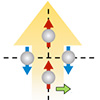
| Schematic illustrations of the physical mechanism underlying asymmetric spin torque in antiferromagnetic systems. At the interface of thin films or devices, symmetry reduction results in unequal absorption of the injected spin current by the A and B sublattices of the antiferromagnet, thereby generating an asymmetric spin torque that drives deterministic switching of the Néel vector. (Image: SHAO Dingfu)
|
|
The new work shifts attention from idealized bulk crystals to the realistic geometry of thin-film devices. At the interface between a spin source and an antiferromagnetic layer, the structural symmetry that would otherwise guarantee equal treatment of the two sublattices is naturally broken. When a spin current enters the film, the A and B sublattices absorb different amounts of spin angular momentum. This imbalance generates a net torque that can decisively reorient the Néel vector.
|
|
“The process is like a seesaw,” explained Prof. Shao. “If equal forces are applied on both sides, the system only oscillates. But even a slight imbalance will decisively tip it.”
|
|
Where a perfectly symmetric spin injection merely drives the Néel vector into persistent oscillation, the asymmetric component provides the directional bias needed for controlled, repeatable switching. The researchers note that this principle mirrors the spin-transfer torque and spin-orbit torque mechanisms already deployed in commercial ferromagnetic memory devices, which suggests a clear route toward technological integration.
|
|
The theoretical model further reveals an inherent resilience in antiferromagnetic storage elements. Strong exchange coupling between the sublattices shields the Néel vector from external magnetic perturbations. Calculations show that the stored state remains intact in applied fields reaching ten times the material’s anisotropy field. That prediction aligns with experimental measurements on the A-type antiferromagnet Cr₂O₃, which maintained its magnetic order under a 3-tesla external field.
|
|
Because the asymmetric spin torque framework depends only on interfacial symmetry breaking, a feature present in virtually any thin-film stack, it is not restricted to antiferromagnets with specific bulk crystal symmetries. This generality eliminates a major materials constraint that had limited earlier switching schemes to a narrow set of compounds.
|
|
By connecting established ferromagnetic spintronic principles to the antiferromagnetic regime through a single, broadly applicable mechanism, the work establishes a practical foundation for developing ultrafast, field-immune antiferromagnetic memory devices.
|