| Mar 03, 2026 |
BIOPIX, a retina-inspired biohybrid image sensor combining biological liquid environments with organic electronics to generate real-time images on a display.
(Nanowerk News) A multidisciplinary team of researchers has developed an innovative image sensor that integrates liquid biological environments with organic electronics, mimicking core functions of the animal retina (Advanced Materials Technologies, “A Bio‐Electronic Hybrid Solid–Liquid Pixelated Color Image Sensor Array as a Direct‐to‐Display Artificial Retina Emulator”).
|
|
Both image photodetector arrays and retinas are pixelated sensors that dynamically extract various features from the visual scene – e.g., color, brightness, and contrast – before transmitting electrical signals to either a graphical interface of a display or the brain. Image sensors rely on solid state semiconductor technology, whereas retinas on photoreceptor cells in water-based ionic environments.
|
 |
| Concept of BIOPIX Vision. A biohybrid color-sensing platform that merges principles of mouse retinal vision (top left) with digital imaging technologies (bottom left). The device integrates polymer-based photodetector pixels with a biological electrolyte (Ames’ medium) to emulate cone- and rod-like responses (right), enabling the direct conversion of light into color and grayscale image outputs. (Image: University of Rome Tor Vergata)
|
|
Unlike conventional solid-state image sensor arrays, the device developed by the researchers, named BIOPIX, operates at the interface between electronics and biology, combining printed organic semiconductor materials with a water-based physiological medium. This integration allows the sensor to capture light through the polymer materials and convert it into electrical signals via a water-based physiological electrolyte in ways that more closely resemble the phototransduction behavior of natural photoreceptors: the rods and cones found in the retina of animal eyes.
|
|
“We designed this device to go beyond traditional electronic sensors,” explains Prof. Thomas M. Brown, at the Electronic Engineering Department of “Tor Vergata”, coordinator of the research. “By letting organic electronic materials interact with a liquid biological environment, BIOPIX reacts to light in a way that is much closer to how a real retina works in nature, both in how it senses color (spectrally) and how quickly it responds.”
|
|
The temporal response of BIOPIX, on the order of tens of milliseconds, mirrors the slower ionic dynamics of liquid-based mammalian retinas, and its sensitivity is comparable to that of established solid state polymer semiconductor photodetectors.
|
|
The array includes 12 pixels that mimic rod-like responses, responsible for low-light and contrast sensitivity, and a central 2×2 array that simulates cone-like di-chromatic sensitivity for color detection in mice.
|
|
“What’s exciting about BIOPIX we developed is that when light strikes the liquid/solid bio-hybrid device, it is converted into electrical signals that are processed and displayed as grayscale from the rod-like pixels and color images from the central cone-like pixels in real time on a display” explains Ebin Joseph, PhD student and first author of the article.
|
|
“The challenge of converting light incident on BIOPIX into direct-to-display pixelated images was addressed by developing a dedicated electronic readout system tailored to its ionic liquid retina-like temporal dynamics” added Dr Luca Di Nunzio, expert in digital electronics and embedded signal processing both from Electronic Engineering Department of “Tor Vergata”.
|
|
Beyond performance, the researchers demonstrated the platform’s biocompatibility. In vitro tests using human mesenchymal stromal cells showed no adverse effects on cell viability, an important milestone for potential biomedical applications. “Confirming biocompatibility was a key step,” said Prof. Antonella Camaioni at the Department of Biomedicine and Prevention of Tor Vergata, co-responsible for the research. “It validates the platform for fundamental research and points toward future possibilities, such as artificial retinal implants or adaptive biointerfaces.”
|
 |
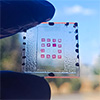
| BIOPIX color perception demonstration. a) Photograph of the fabricated multi-pixel biohybrid BIOPIX devices featuring a 16-pixel architecture that mimics rod- and cone-like photoreceptors. b) & c) Experimental setup and digital reconstruction of a grayscale (rod-like artificial photoreception) and color (cone-like photoreception) image obtained when the BIOPIX array was illuminated with green and green plus violet light of increasing intensity and connected to a display monitor via dedicated electronics. (Image: University of Rome Tor Vergata)
|
|
“Our work represents an important first step toward emulating how the retina forms images, with a long-term goal of developing better retinal prosthetic devices. With BIOPIX, we aim to mimic the spectral and temporal behaviour of the mouse retina, a widely used model for studying degenerative eye diseases, such as retinitis pigmentosa and age-related macular degeneration, that lead to photoreceptor loss and vision impairment.” explains Dr Hiroki Asari, expert in Visual Systems Neuroscience at EMBL.
|
|
The researchers emphasize that BIOPIX is more than a novel sensor: it is a scalable, versatile platform for studying how light is converted into electrical signals at the interface of biological and artificial systems. This retina emulator platform could aid in the development of artificial photoreceptors, help us better understand the biophysics of phototransduction, natural vision and inspire new technologies in artificial vision and neural interfacing.
|
|
“The BIOPIX retina emulator platform can, for example, be used to study new photoabsorbing artificial photoreceptor materials and physiological media prior to retinal implantation or injection, as well as to evaluate their performance under varying environmental conditions. In addition, it can help understand differences in image sensing operating in fully solid-state mode versus that at the interface between biological (liquid) and semiconducting (solid) matter in a field where biology and technology are coming together to enable new possibilities.” added Thomas Brown
|
|
Understanding the underlying biophysics, can help in the quest of restoring vision to those who have lost it through degenerative retinal diseases as well as help improve function of the visually impaired.
|
|
The Vice President for Research of Tor Vergata University of Rome, Prof. Massimo Federici, commented that “These results highlight the power of collaboration, bringing together researchers with assorted expertise, supported by diverse funding programs from our university, as well as local, and international agencies, to tackle complex challenges at the intersection of electronics, biology, bio-physics, engineering, retina neuroscience, and bio-medicine.
|
|
Looking ahead, the team sees BIOPIX as a step toward smarter artificial vision and new kinds of technology where light, electronics and biology work together.
|