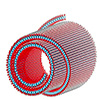
Rolling MXene sheets into scrolls at gram scale yields 33-fold conductivity gains and superconductivity at 5.2 K absent in flat films, enabling energy and sensing advances.
(Nanowerk Spotlight) Rolling a flat sheet into a tube seems like a simple geometric transformation, but for MXenes it has proven persistently difficult to achieve in a controlled way. Researchers have occasionally spotted scrolled structures mixed in with flat flakes, yet these appeared by accident rather than design, their formation mechanism unclear.
Previous deliberate attempts yielded scroll-like aerogels that turned out to be surfactant-assembled fibers without true tubular channels. A recent approach used chemical treatment to riddle MXene sheets with defects that induced curling, but the high defect densities required could compromise structural integrity and stability.
This gap matters because the shift from two dimensions to one dimension has repeatedly unlocked new properties in other layered materials. Carbon nanotubes conduct electricity with remarkable efficiency along their length and serve as molecular channels for ion transport. Boron nitride and molybdenum disulfide tubes exhibit quantum confinement effects absent in their flat forms. If MXenes could be reliably rolled into scrolls, entirely new functionalities might emerge.
A research team at Drexel University and the University of Pennsylvania has now overcome this barrier. In a paper published in Advanced Materials (“Scalable Synthesis of MXene Scrolls”), they report a scalable method for manufacturing MXene scrolls across six different compositions. These include titanium carbonitride, titanium carbide, vanadium carbide, niobium carbide, and tantalum carbide, spanning MXenes with two, three, and four transition metal layers. A single batch yields up to 10 g of pure scrolled material, with delamination efficiencies reaching 45% by weight relative to the starting MAX phase precursor.
The scrolled MXenes exhibit strikingly different properties from flat flakes. Most dramatically, scrolled niobium carbide becomes superconducting at 5.2 K while the identical composition in flat form shows no superconductivity down to 2.5 K.
Proposed schematic of self-scrolling MXene flakes showing the mechanism: (a) surface hydroxyl groups (-OH) of a multi-layer MXene are deprotonated or dissociated by water molecules, creating dissimilar surfaces on the outermost flakes; (b) an OH-rich inner surface and OH-deficient outer surface form, inducing compressive stress on the outer surface; (c) lattice strain drives scrolling and separation of the MXene flake from the multilayer particle; (d) conceptual models of Ti₂CTx, Ti₃C₂Tx, and Ta₄C₃Tx scrolls illustrate the curling process. (Image: Reproduced with permission from Wiley-VCH Verlag ) (click on image to enlarge)
The synthesis builds on standard MXene production, where hydrofluoric and hydrochloric acids selectively etch aluminum from layered MAX phase precursors. The innovation lies in what happens next. During delamination, lithium ions wedge between MXene layers while mechanical shaking separates them. By using shorter etching times and lower temperatures to preserve hydroxyl groups on the MXene surface, then exposing the delaminated sheets to water, the researchers trigger spontaneous scrolling.
The mechanism hinges on asymmetric surface chemistry. When multilayer MXene particles sit in water, the outermost exposed surface reacts with water molecules that strip hydrogen atoms from surface hydroxyl groups, converting them to oxygen terminations. This releases hydrogen ions, dropping the solution’s pH.
The result is a sheet with chemically distinct faces. The outer surface becomes oxygen-rich while the inner surface retains more hydroxyl groups. Oxygen-terminated MXene has a smaller atomic lattice spacing than hydroxyl-terminated MXene, so the outer surface experiences compressive strain relative to the inner. This mismatch generates a bending moment that curls the sheet into a scroll. As each layer rolls away, the next becomes exposed to water and undergoes the same transformation, peeling off one scroll at a time.
X-ray photoelectron spectroscopy confirms this picture, revealing a significant drop in hydroxyl groups and rise in oxygen terminations as MXene transitions from flat to scrolled. Ultraviolet-visible spectroscopy captured the transformation in real time: over several hours, optical absorption shifted and films changed from golden to dark as hydroxyl groups converted to oxygen.
Crucially, electrochemical treatment reversed these changes, restoring the original color and optical signature. This proves the scrolling arises from controllable surface chemistry rather than irreversible degradation.
The rolled structures range from 0.5 to 3 µm in width and tens of nanometers in thickness when flattened on substrates, with lengths extending up to 35 µm. Thicker MXene compositions form wider, ribbon-like scrolls, while thinner ones curl into narrower tubes. High-resolution transmission electron microscopy confirmed that crystallinity remains intact even in highly curved regions.
The scrolled morphology dramatically alters electronic behavior. Films of scrolled niobium carbide showed electrical conductivity 33 times higher than flat films of the same material. Even more striking, scrolled niobium carbide underwent a superconducting transition at 5.2 K that flat films completely lacked. The transition broadened and shifted to lower temperatures under applied magnetic fields, characteristic of type-II superconductivity. The researchers propose that strain from scrolling modifies the electronic structure enough to enable this transition, though disentangling strain effects from surface chemistry changes requires further study.
Beyond electronics, the open tubular geometry enhances ion and molecule transport. In supercapacitor electrodes, scrolled titanium carbonitride retained 3.7 times the charge storage capacity of flat electrodes at scan rates of 1000 mV s⁻¹, where ion diffusion normally limits performance in densely stacked flat films. Humidity sensors made from scrolled films responded to breath cycles with 10 times greater sensitivity than flat counterparts, with no hysteresis between inhalation and exhalation. Water molecules adsorb and desorb rapidly through the porous scroll network.
The scroll dispersions also behave as electrorheological fluids whose properties change under applied electric fields. An alternating current field at 10 kHz caused scrolls to align parallel to the field within approximately five seconds. Removing the field returned them to random orientation within seconds. At dilute concentrations around 0.05 mg mL⁻¹, this alignment was fully reversible, switching the dispersion between electrically insulating and conductive states. Above 0.1 mg mL⁻¹, however, field-aligned scrolls locked into permanent interconnected networks spanning electrode gaps, offering a route to fabricating directional conductors from liquid dispersions.
The ability to produce gram-scale quantities of MXene scrolls with controlled morphology opens experimental territory that flat flakes cannot access. The emergence of superconductivity in scrolled niobium carbide demonstrates that morphological engineering alone can unlock electronic phases absent in the parent material. Enhanced ion transport makes scrolled MXenes promising for fast-charging energy storage and rapid-response chemical sensors. Field-directed assembly offers pathways to aligned architectures for electronics and photonics. The method works across multiple MXene compositions and structures, suggesting broad applicability as it extends across the wider MXene family.
For authors and communications departmentsclick to open
Lay summary
Prefilled posts
Nanowerk Newsletter
Get our Nanotechnology Spotlight updates to your inbox!
Thank you!
You have successfully joined our subscriber list.
Become a Spotlight guest author! Join our large and growing group of guest contributors. Have you just published a scientific paper or have other exciting developments to share with the nanotechnology community? Here is how to publish on nanowerk.com.