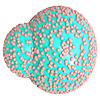
A self-propelled nanoparticle engineered through computer simulation could bring laboratory-grade cancer detection to paper-based bedside tests.
(Nanowerk Spotlight) A cancer cell can shed telltale proteins into the bloodstream long before a tumor becomes visible on a scan. But finding those molecules is like searching for a handful of sand grains scattered across a swimming pool, except the water has the consistency of honey and your search tools can barely move.
This is not just a metaphor. At the microscale, fluids behave nothing like the turbulent water we experience in everyday life. Viscous forces overwhelm inertia, and tiny objects become trapped in a regime where movement relies almost entirely on diffusion, the slow and random drift of particles through a medium.
Traditional immunosensors use antibody-tagged particles to bind and signal the presence of disease markers. They perform adequately in clean laboratory buffers. But in the thick, protein-rich environment of human blood, their nanoscale probes struggle to move, collide with targets too infrequently, and lack the sensitivity to catch diseases early.
Researchers have responded by developing nanomotors: particles that propel themselves through fluid under an external stimulus such as light. By actively swimming rather than passively drifting, these tiny machines encounter far more target molecules per unit time.
Yet most nanomotors reported to date rely on simple, symmetric shapes such as spheres or basic Janus particles, named for the two-faced Roman god because they have distinct halves. These geometries convert energy into motion inefficiently, producing random trajectories and wasting energy.
Nature solved this problem long ago. Fish, tadpoles, and certain bacteria all exploit asymmetric body plans that minimize drag and maximize thrust. Applying that same principle at the nanoscale, however, has proved difficult because designing and fabricating precisely asymmetric structures at such dimensions demands both computational guidance and exacting chemistry.
A study published in Advanced Functional Materials (“Inverse Design-Driven Topological Engineering of Nanomotors for Ultra-Efficient Capture and Sensing”) tackles exactly this challenge. A research team based primarily at Xi’an Jiaotong University reports an inverse design strategy in which computational simulations first identify the ideal nanomotor shape, and experimentalists then synthesize it with high precision.
The result is a asymmetric, two-lobed nanoparticle that moves nearly four times faster than a symmetric counterpart and captures a common cancer biomarker with 104.1-fold greater sensitivity than a conventional gold-nanoparticle-based immunosensor.
Numerical simulation of thermophoretic propulsion of four types of nanomotors. (a) Schematic defining the morphological asymmetry ratio in a snowman-like asymmetric structure. (b) Schematic of snowman-like nanoparticles with varying morphological asymmetry ratios (0, 0.4. 0.7, 1.0). (c-f) Steady-state thermal distribution of four morphological asymmetry ratios nanomotors under laser irradiation at 808 nm and 1.0 W cm−2. (g-j) Simulation of temperature gradient of four morphological asymmetry ratios nanomotors under laser irradiation at 808 nm and 1.0 W cm−2. (k-n) The self-thermophoretic force was obtained by evaluating the local thermal gradient, with boundary conditions imposed at the two termini of the model. (o) Schematic diagram of the self-propulsive motion of snowman-like nanomotors under NIR laser irradiation. (p) The thermophoresis force of four nanomotors. The MSD values (q) and calculated diffusion coefficient (r) of four snowman-like nanomotors. (s-v) Representative trajectories of four snowman-like nanomotors. (Image: Reproduced with permission from Wiley-VCH Verlag) (click on image to enlarge)
The inverse design approach starts from the desired function and works backward to the optimal structure. The researchers defined their goal as maximizing propulsion efficiency and target capture in viscous fluid. They then used computational models to screen candidate architectures. Each asymmetric candidate was described by a single number: the morphological asymmetry ratio (R), the longest dimension of the smaller “head” lobe divided by the diameter of the larger “base” sphere. Four R values were tested, spanning from a perfect sphere to a fully symmetric dumbbell.
Simulations modeled what happens when a gold coating on each particle absorbs near-infrared laser light. Gold converts this light into heat through plasmonic resonance, a phenomenon in which light energy excites collective oscillations of electrons at a metal surface. In symmetric structures, the resulting temperature field spreads evenly, producing no net driving force.
Asymmetric shapes, however, generate uneven temperature gradients. The head side becomes hotter than the base side, creating a thermophoretic force, a push that arises whenever a temperature difference exists across a small object in fluid. Among the four candidates, the version with R = 0.7 produced the steepest gradient and the strongest net driving force, while both fully symmetric designs generated none at all.
Translating these simulations into physical particles required carefully controlled chemistry. The team began with uniform polystyrene nanospheres a few hundred nanometers across. They grew a silica-based lobe on one side of each sphere by polymerizing a silane precursor at the liquid-liquid interface. Varying the amount of precursor tuned the size of this lobe and thus the degree of asymmetry. A coating of gold nanoparticles then covered the entire surface, creating the final hybrid structure designated PZSA.
Electron microscopy confirmed the two-lobed asymmetric shape, and elemental mapping showed carbon concentrated in the polystyrene base, silicon in the head, and gold distributed uniformly. Under near-infrared laser irradiation, a PZSA suspension heated from about 32 °C to 49 °C in 10 minutes, far outpacing particles lacking the gold shell. The nanomotors held their heating efficiency over multiple cycles, indicating good stability.
Motion tracking under a microscope validated the simulation predictions. The PZSA nanomotor (R = 0.7) moved roughly four times faster than the symmetric sphere and the symmetric dumbbell. Raising laser power boosted PZSA’s speed further, while symmetric particles showed no meaningful improvement. This confirmed that shape, not just energy input, determines propulsion efficiency.
Faster movement translated directly into better biosensing. The researchers attached antibodies against carcinoembryonic antigen (CEA), a widely used cancer biomarker, to each nanomotor type. They then incubated the particles with fluorescently labeled CEA molecules.
Microscopy revealed dramatically brighter fluorescence around PZSA particles than around any other configuration, meaning each one captured far more targets. Simulations estimated that a laser-driven PZSA nanomotor explores nearly five times more area than a stationary particle in the same time window, explaining the leap in capture efficiency.
The team then built a practical diagnostic device by integrating PZSA nanomotors into a lateral flow immunoassay strip, the same paper-based format used in home pregnancy and rapid antigen tests. The PZSA-based strip proved 104.1 times more sensitive than a conventional gold-nanoparticle version when detecting CEA, with a useful detection range spanning three orders of magnitude down to the low picogram-per-milliliter level.
Clinical validation strengthened the case. Testing serum from eight breast cancer patients and 38 healthy individuals, the PZSA-based strip showed strong agreement with a standard hospital-grade chemiluminescent immunoassay, a laboratory technique that uses light-emitting chemical reactions to quantify biomarker levels. Statistical comparison confirmed that the two methods produce nearly interchangeable results, suggesting the nanomotor strip could serve as a viable point-of-care alternative.
The design framework itself may carry as much practical value as the specific particle it produced. Starting from a performance objective, computationally screening topologies, and then synthesizing the winner is an approach the authors note could extend to other combinations of polymers, oxides, and metals beyond the system tested here.
If validated across additional biomarkers and clinical settings, inverse-designed nanomotors could bring rapid, inexpensive bedside diagnostics closer to the sensitivity levels currently achievable only with costly laboratory instruments.
For authors and communications departmentsclick to open
Lay summary
Prefilled posts
Nanowerk Newsletter
Get our Nanotechnology Spotlight updates to your inbox!
Thank you!
You have successfully joined our subscriber list.
Become a Spotlight guest author! Join our large and growing group of guest contributors. Have you just published a scientific paper or have other exciting developments to share with the nanotechnology community? Here is how to publish on nanowerk.com.