Glycine replaces toxic precursors in solvent-free graphene production, yielding nanoplatelets with high conductivity and month-long dispersion stability that enable electrically triggered self-healing.
(Nanowerk Spotlight) Graphene’s practical applications remain limited by a fundamental tension: the material disperses poorly in solvents and polymer matrices, yet the most common fix, surface oxidation, destroys electrical conductivity. Nitrogen doping offers a potential solution by introducing polar functionalities that improve dispersibility while preserving conductive pathways.
But most nitrogen doping methods demand extreme conditions. Chemical vapor deposition requires temperatures exceeding 760°C. High pressure synthesis operates at 30 MPa. Wet chemical routes often involve toxic reagents like hydrazine or volatile organic solvents.
Mechanochemical approaches, which use mechanical force to drive reactions without solvents, have seemed promising but still rely on problematic nitrogen sources. Melamine is toxic. Pressurized nitrogen gas demands specialized equipment and acid washing for purification. Post annealing steps add significant energy costs. A persistent gap has separated nitrogen doped graphene’s theoretical appeal from its environmentally sustainable production at scale.
A study published in ACS Sustainable Chemistry & Engineering (“Green Mechanochemical Production of Amino-Acid-Derived N-Doped Graphene for Functional Vitrimer Composites”) presents a method that closes this gap. Researchers at Monash University in Australia developed a one pot, solvent free mechanochemical process that produces nitrogen doped graphene nanoplatelets using glycine, a naturally occurring amino acid, as the nitrogen source. Combined with potassium hydroxide in a planetary ball mill, glycine enables simultaneous exfoliation and nitrogen incorporation at ambient temperature and pressure, requiring no harsh post treatment.
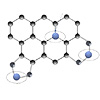
Mechanochemical synthesis of nitrogen-doped graphene nanoplatelets (N-GNPs). (a) Graphical illustration and (b) molecular structures of the solid-state mechanochemical route for the synthesis of N-GNPs. During the ball milling, glycine reacts with KOH and forms nucleophiles while graphite undergoes exfoliation and generation of active carbon species such as carbocations and carboradicals. These active carbon species and in situ generated nucleophiles react to generate N-GNPs. (Image: Reproduced with permission from American Chemical Society)
The approach satisfies several green chemistry principles: waste prevention, use of less hazardous chemicals, safer solvents, reduction of unnecessary derivatization, and inherently safer design. The team quantified these benefits using two sustainability metrics. The E factor, measuring waste generated per unit of product, came in at 88, among the lowest reported for solid state nitrogen doping, compared to 135 for melamine-based routes and 17,000 for wet ball milling of graphene oxide with melamine. The CO₂ emission factor, accounting for reagent production and electricity consumption, also showed marked improvement over hydrothermal and pyrolytic alternatives.
The synthesis relies on complementary reactions occurring simultaneously. During high energy ball milling at 400 rpm, graphite flakes undergo repeated collisions that physically exfoliate bulk material into thinner sheets while generating reactive carbon species through carbon carbon bond cleavage.
Concurrently, potassium hydroxide deprotonates glycine’s amino group, creating nitrogen containing nucleophiles that attack electron deficient carbon centers on the graphene surface. This covalently incorporates nitrogen into the lattice. The process achieved approximately 80% yield over 20 hours.
X ray photoelectron spectroscopy confirmed three distinct nitrogen configurations: pyridinic, pyrrolic, and graphitic, totaling approximately 2.3% nitrogen content. Graphitic nitrogen contributes extra electrons to graphene’s π conjugated system, directly enhancing conductivity.
The resulting nanoplatelets exhibit a combination of properties that competing methods have failed to achieve simultaneously. Pristine graphite powder showed electrical conductivity of 3000 S/m but dispersed poorly in all solvents tested. Control samples ball milled without glycine and potassium hydroxide showed drastically reduced conductivity of around 30 S/m due to amorphous carbon formation.
The nitrogen doped material achieved 1170 S/m, roughly 30% that of starting graphite, while gaining excellent dispersibility in water, ethanol, terpineol, cyrene, and hexylene glycol. Only dibasic ester failed to stabilize the nanoplatelets, which the researchers attribute to its limited polarity and weak hydrogen bonding capability.
In compatible solvents, dispersions remained stable for up to one month. Zeta potential measurements confirmed values of −32.6 ± 0.9 mV in water and −23.1 ± 1.6 mV in ethanol, indicating robust colloidal stability.
To verify that nitrogen rather than oxygen drove this enhanced dispersibility, the team thermally reduced the nanoplatelets to remove oxygen containing groups while preserving nitrogen content. The reduced material (containing approximately 5.0 at% oxygen and 2.0 at% nitrogen, compared to 8.0 at% oxygen and 2.3 at% nitrogen before reduction) maintained comparable zeta potential values while conductivity increased to 1478 S/m, confirming nitrogen’s central role.
The researchers demonstrated practical utility by incorporating nitrogen doped graphene into vitrimer composites, recyclable thermosets whose covalent bonds rearrange through exchange reactions when heated, enabling reshaping and repair. Adding less than 1 wt% nanoplatelets to an epoxy based vitrimer increased tensile strength by 73% and raised decomposition temperature by 11°C, notably lower filler loading than the greater than 10 wt% often required with conventional carbon fillers.
The nanoplatelets also enabled electrically triggered self-healing. Composite electrical resistance dropped to approximately 0.013 Ω, compared to 2976 MΩ for the unfilled vitrimer. Applying 16 V raised composite temperature to 158°C within 120 seconds, sufficient to activate transesterification reactions that allow vitrimer network reconfiguration. Scratches measuring 62 μm and 176 μm wide healed completely after 6 minutes of electrical stimulation. The neat vitrimer, lacking adequate thermal conductivity to distribute generated heat, showed no healing under identical conditions.
A notable finding concerned stress relaxation. Adding 1 wt% unfunctionalized graphite to the vitrimer slowed stress relaxation dramatically, requiring 398 seconds compared to 30 seconds for neat vitrimer at 200°C. Nitrogen doped nanoplatelets accelerated relaxation to just 16 seconds. The researchers attribute this to strong interfacial interactions between nitrogen functionalized surfaces and the vitrimer matrix, creating a more homogeneous dynamic network with improved local heat transfer.
Crucially, the topology freezing temperature, below which the vitrimer behaves as a conventional thermoset, remained essentially unchanged at approximately 95°C (compared to 94°C for the neat vitrimer), preserving the processing window.
This work establishes glycine derived nitrogen doped graphene as a viable filler for sustainable, multifunctional composites. The synthesis eliminates toxic dopants, avoids volatile solvents, operates at ambient conditions, and produces material that enhances both durability and repairability of polymer coatings.
For authors and communications departmentsclick to open
Lay summary
Prefilled posts
Nanowerk Newsletter
Get our Nanotechnology Spotlight updates to your inbox!
Thank you!
You have successfully joined our subscriber list.
Become a Spotlight guest author! Join our large and growing group of guest contributors. Have you just published a scientific paper or have other exciting developments to share with the nanotechnology community? Here is how to publish on nanowerk.com.