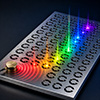
Patterned elastic plate guides ultrasonic waves and traps different frequencies at separate bulk locations, enabling compact multiplexed signal routing and energy harvesting.
(Nanowerk Spotlight) Ultrasound is best known from medical imaging, where high-frequency sound waves travel through tissue and return information about what lies inside. The same basic kind of wave also moves through solid materials. Engineers use it to inspect aircraft parts, monitor pipelines, detect cracks in structures, drive tiny actuators, and harvest mechanical energy from vibrating systems. In each case, the device does not handle “sound” as something we hear. It handles mechanical motion moving through matter.
That motion often contains more than one frequency. Different frequencies can carry different information, respond to different defects, or serve different functions inside the same device. A practical ultrasonic system may therefore need to guide several frequencies through a solid and then separate them so each one can be measured, processed, or converted into electrical energy. Doing this inside a compact structure remains difficult because trapping and transport usually pull in opposite directions.
Many engineered structures can localize selected frequencies, but strong localization often stops the wave from carrying energy forward. Other structures can guide waves, but they do not automatically divide different frequencies into separate locations. A paper in Advanced Functional Materials (“Realization of Rainbow Chiral Landau Levels for Multiplexed Ultrasonic Energy Trappings”) addresses that design conflict with a patterned aluminum plate that routes ultrasonic waves and sorts them by frequency inside the bulk of the material.
The researchers also show that the sorting route can curve and that the effect survives when the plate itself bends. Their device uses a wave-state mechanism borrowed from magnetic-field physics, but it recreates that mechanism through geometry rather than through actual magnetic forces. The formal name is rainbow chiral Landau levels. In this context, “rainbow” means that different frequencies occupy different positions, while “chiral” means the wave can still carry energy in a preferred direction.
Conceptual schematic of the proposed system. (Image: Reproduced with permission from Wiley-VCH Verlag)
Landau levels are quantized energy states that arise when charged particles move under a magnetic field. In electronic materials, they help explain phenomena such as the quantum Hall effect, where electrons follow highly constrained paths rather than moving freely through all available states. Similar discrete wave states can appear in patterned classical systems when geometry recreates the mathematical conditions normally produced by magnetic fields. Sound waves do not respond to magnetic fields in the same way, so the plate’s internal pattern supplies the needed control.
This is the design logic behind multifunctional metamaterials for energy harvesting and vibration control: the structure gains unusual behavior from its shape and layout rather than from a new chemical composition. In this work, repeated split-ring shapes cut into aluminum form the basic building blocks. By changing those shapes gradually across the plate, the researchers control how flexural ultrasonic waves move through the solid.
The key distinction is not simply whether the device traps sound. It is whether it can trap sound after the wave has traveled in a controlled way. Earlier rainbow Landau-level systems used flat Landau levels, which localize energy but have zero group velocity. That means they do not carry energy forward. Chiral Landau levels retain finite group velocity, so the wave can still transport energy before it localizes.
The device creates this behavior by tuning two features of each unit cell in the patterned plate. One feature changes vertically across the structure. This variation opens and inverts a local bandgap, which produces an in-plane pseudo-magnetic field. In plain terms, the plate’s geometry makes the vibration states arrange themselves as though a magnetic-like field acts on the wave.
A second feature changes horizontally across the plate. This variation creates a deliberate frequency slope from one side of the device to the other. Physicists describe that slope as a pseudo-electric field because it shifts the local wave state in a controlled spatial direction. When the two gradients act together, the main chiral Landau level becomes a rainbow sequence. Lower frequencies stop closer to one side, and higher frequencies stop farther along the plate.
This mechanism differs from many topological wave devices that place energy mainly at edges or corners. The calculated vibration modes in this device concentrate inside the central region of the plate. That bulk localization matters because sensors, transducers, or energy harvesters could access the trapped waves inside the device rather than only along narrow boundaries. It also connects the work to wider efforts to use engineered periodic structures to control wave behavior.
The predicted behavior appeared first in the calculated vibration modes. As the synthetic fields changed across the plate, the localized states did not remain fixed. They shifted across the structure in frequency order, with modes from 0.335 MHz to 0.374 MHz appearing at progressively different positions. In simulations, the reported high quality factors indicated that the energy remained tightly confined under the modeled conditions rather than spreading through the lattice.
The fabricated plate turned that prediction into a directly measured map of motion. A piezoelectric disk launched ultrasonic waves from one side, while a scanning laser vibrometer recorded how the surface moved. The strongest vibration response did not appear everywhere at once. It moved from point to point as the frequency changed, matching the expected rainbow sequence inside the plate.
The full-field measurements made the sorting effect visible. Waves entering from the same location separated into distinct trapped regions, each tied to a different frequency. The experiment resolved at least eight usable ultrasonic channels, which is the practical meaning of the rainbow effect here. A single input can feed multiple frequency-selective locations inside one solid structure, without requiring a separate path for each channel.
The same design principle also gave the researchers control over the route. By changing how the resonator orientation varied vertically, while keeping the horizontal frequency slope, they bent the sequence of trapping sites into an arc. The measured vibration fields followed that designed curve. The device therefore did more than sort frequencies along a straight line; it encoded the path of that sorting into the pattern itself.
A further test showed that the effect did not depend on keeping the plate flat. The researchers warped the patterned aluminum sheet into a curved shape with a curvature radius of 196.95 mm. The separated trapping sites remained. Different ultrasonic frequencies still settled at different positions along the curved device, supporting the claim that the Landau-level mechanism can tolerate the tested structural deformation.
The work connects to research on topological metamaterials that control mechanical vibrations, but its emphasis is more specific. The device does not only protect a path or trap a single mode. It creates several frequency channels inside one bulk structure. That feature could matter for ultrasonic systems that need parallel signal handling without building a separate physical route for every frequency.
The paper does not present a finished ultrasonic processor or energy harvester. It presents the physical mechanism and an experimental platform. Future devices would need integrated transducers, efficient coupling, loss control, and smaller-scale fabrication. The authors point toward GHz-scale on-chip elastic circuits, but the demonstrated system operates in the MHz ultrasonic range. That distinction keeps the engineering outlook clear.
The most immediate opportunity lies in placing useful components at the trapping locations. Piezoelectric harvesters could collect selected frequency channels, while sensors could read different ultrasonic bands at separate points. Signal-processing layouts could use one input instead of many separate paths. The value of the approach comes from encoding the routing and sorting function into the material itself.
The work shows that ultrasonic frequency separation does not have to mean choosing between a traveling wave and a stationary trap. In this patterned plate, the wave can move through the structure, divide into frequency-specific locations, and remain accessible inside the bulk. That combination could give future ultrasonic devices a more compact way to route information or collect vibrational energy, using the geometry of the solid as part of the circuit rather than as a passive support.
For authors and communications departmentsclick to open
Lay summary
Prefilled posts
Nanowerk Newsletter
Get our Nanotechnology Spotlight updates to your inbox!
Thank you!
You have successfully joined our subscriber list.
Become a Spotlight guest author! Join our large and growing group of guest contributors. Have you just published a scientific paper or have other exciting developments to share with the nanotechnology community? Here is how to publish on nanowerk.com.