| Jun 04, 2026 |
By showing when MXenes shift from order to disorder and how that affects performance, scientists are building a roadmap for tailored materials.
(Nanowerk News) Designer jeans. Designer handbags. Designer materials?
|
|
Scientists at Argonne National Laboratory are helping show what it means to design a material almost atom-by-atom. In two recent publications, scientists show they can carefully choose the types of atoms in a material, where those atoms sit and what is attached to the surfaces of its atom-thin layers. That level of control lets them tailor a fast-growing class of materials called MXenes for specific jobs across a wide range of technologies, including energy storage, catalysis, electronics, communications, biomedicine and even space systems.
|
|
MXenes are a family of very thin, sheet-like materials, often just a few atoms thick. They are made mainly from transition metals, such as titanium, vanadium or molybdenum, bonded to carbon and/or nitrogen. MXenes begin as layered solids called MAX phases. When researchers chemically remove one type of layer from a MAX phase, the remaining layers can be separated into thin, flat sheets — MXenes.
|
|
“I like to imagine MAX phases as a textbook with all the pages glued shut and MXenes as a single page you want to extract,” explained Brian Wyatt, a Maria Goeppert Mayer Fellow at Argonne. “You have to dissolve the glue and coax that page out. The glue and pages represent different chemical environments, so atoms prefer to be near certain layers.”
|
|
MXenes are 2D materials that have drawn wide interest because, unlike other 2D materials like graphene, which is made only of carbon, they can be built from many different combinations of elements. That gives scientists many more ways to tune how the materials behave.
|
 |
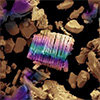
| A stylized scanning electron microscopy image of a multi-layer stack of MXenes. (Image: Brian Wyatt, Babak Anasori and Devynn Leatherman-May)
|
Where order gives way to disorder
|
|
Published in the journal Science (“Order-to-disorder transition due to entropy in layered and 2D carbides”), Argonne scientists have recently pushed this idea to new frontiers by creating dozens of new MAX phase compositions, nearly doubling the known chemical space that can be used to make MXenes.
|
|
Their goal was to explore how the arrangement of atoms in MAX phases, and in the 2D MXenes made from them, changes as more different metals were mixed together. They made 40 different MAX phases, each containing at least two different metals and, in some cases, as many as nine different metals in just one structure.
|
|
This work let the team answer a basic question: How many different elements can be packed into one material before the atoms stop arranging themselves in an orderly way?
|
|
The answer is important because atomic arrangement affects how a material behaves. In simpler mixtures, some atoms prefer certain positions. Some sit closer to the outer layers. Others prefer the center of the structure. But as more kinds of atoms are added, that order becomes harder to maintain.
|
|
The researchers found that this ordering can persist when the material contains up to six different metals. At seven or more, the pattern breaks down and the atoms become truly disordered.
|
|
“This is where entropy, the natural tendency toward randomness, wins,” Wyatt said. “Nature likes some kinds of order, but once we add enough different ingredients, it becomes too hard for the atoms to stay organized.”
|
|
To see this directly, the team used a technique called secondary ion mass spectrometry, or SIMS, which allowed them to measure the makeup of the material layer by layer. That gave them a detailed look at where different atoms were located inside the structure.
|
|
The work also showed that this change from order to disorder affects what happens after the MAX phases are turned into MXenes. When MXenes form, atoms and small chemical groups from the surrounding solution attach to their surfaces. These surface groups can strongly affect how the material conducts electricity, stores energy or helps speed up a chemical reaction.
|
|
“Computational models had predicted that MAX phases with seven, eight or nine metals shouldn’t be stable,” said Argonne materials scientist Sixbert Muhoza. “But we showed that they can actually be synthesized and stabilized by entropy. That’s a key finding — it means entropy can enable materials that were thought to be impractical or unstable.”
|
A roadmap for designing MXenes
|
|
A broader review of the MXene field, published in Nature Reviews Materials (“Composition–structure–property relationships in MXenes”), shows just how much room scientists now have to design these materials for real uses. The review lays out how MXenes’ composition, structure and surface chemistry work together to control their properties.
|
 |
| Future applications of MXenes include biomedicine, communication technology, optoelectronics, space technology, catalysis, quantum technology and thermal management. (Image: Jongyoun Kim and Yury Gogotsi, Drexel University) (click on image to enlarge)
|
|
Researchers can tune which metals are present, how much carbon or nitrogen is included, what chemical groups are attached to the surface, whether atomic-scale defects are present and even the spacing between stacked sheets. Small changes at that scale can produce large changes in performance.
|
|
“We like to say that these are like designer materials,” Wyatt said. “If I want a certain application, I use these compositions; if I want something different, I use others. The class is so big, we can design for what we need.”
|
|
That design flexibility is why MXenes are being explored for so many uses. One especially promising use is electromagnetic interference shielding. As electronic devices become smaller and more powerful, unwanted electromagnetic signals become a bigger problem. MXenes can block this interference very well, even in coatings that are only nanometers thick.
|
|
Researchers are also studying MXenes for catalysis, where chemical reactions happen on a surface. Because MXenes are 2D, many of their atoms are exposed and available to do useful work. That could reduce the amount of costly materials, such as platinum, needed in some reactions.
|
|
“The tunability of MXenes is key for catalysis,” Muhoza said. “Sometimes you need specific metals as active sites, but only a small area of bulk material is actually active. With MXenes, you can put those metals on a 2D structure, so they’re all exposed.”
|
|
The review also points to future uses in biomedicine, communications, quantum technology, thermal management and extreme environments. In each case, the main idea is the same: tailor the material at the atomic scale to match the job.
|
Tailoring the future
|
|
The next challenge is scale. Scientists now know much more about how to design MXenes but turning that knowledge into products will require larger-scale manufacturing and industry adoption.
|
|
Artificial intelligence and machine learning may help speed that process by narrowing down which combinations of elements are most worth testing. Researchers also see MXenes as promising for technologies that need high performance and low energy use, including advanced electronics, data centers and grid systems.
|
|
“We’re really only beginning to see what these materials can do,” Muhoza said. “Because MXenes are so tunable, they give us a way to build materials for very specific needs instead of settling for one-size-fits-all.”
|
|
In a world that increasingly needs materials built for harder and more specialized jobs, MXenes may offer something rare — a material platform scientists can truly design.
|