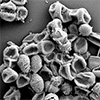
An edible biohybrid makes swallowed nanoplastics clump inside the gut, reducing intestinal penetration and helping the body expel them in feces.
(Nanowerk Spotlight) People ingest tiny plastic particles, micro- and nanoplastics, through ordinary food and drink. They have been reported in drinking water, table salt, seafood, and other common parts of the diet, which makes exposure difficult to avoid. After swallowing, larger particles often leave the digestive tract with food residues. The smallest particles, measuring nanometers, can move through mucus and pass into intestinal tissue.
Once nanoplastics cross the gut wall, they are no longer only a digestive contaminant. Their small size can allow them to enter the bloodstream and accumulate in organs including the liver, kidneys, and brain. Recent Nanowerk coverage of how nanoplastics affect neurons depending on their size has also highlighted that smaller particles can build up inside neurons and alter cell behavior.
The gut is therefore the first biological barrier that can stop swallowed nanoplastics before they become internal exposure. Most current strategies act too early or too late. Water treatment can reduce one source of intake, but it cannot address all plastic particles that enter food chains and consumer products. Anti-inflammatory treatments or tissue-protective therapies act after particles have already entered tissue. What is missing is a way to keep swallowed nanoplastics inside the gut lumen long enough for the body to expel them.
The system combines live Enterococcus faecalis, a tea-derived polyphenol called epigallocatechin gallate, and ferric ions. Together, these components chemically age nanoplastics inside the gut, causing them to clump into larger aggregates that are less able to cross the intestinal barrier and more likely to leave in feces.
An edible biohybrid platform chemically ages swallowed nanoplastics in the intestine, causing them to aggregate into larger clusters that remain near the gut lumen instead of crossing into intestinal tissue. (Image: Adapted from DOI:10.1002/advs.75918, CC BY)
The key conceptual move is to treat nanoplastics not only as contaminants to remove, but as particles whose behavior can be redirected after ingestion. Earlier work has examined probiotic binding as a way to promote nanoplastic excretion. This study goes further by using local chemistry to alter particle surfaces, turning mobile nanoscale plastics into larger gut-confined clusters.
That chemistry relies on the Fenton reaction, an iron-mediated process that generates hydroxyl radicals from hydrogen peroxide. These radicals are powerful oxidants. Their strength makes them useful for attacking polymer surfaces, but it also creates a safety problem because uncontrolled oxidation can injure tissue. The platform’s design addresses that trade-off by generating short-lived reactive species locally, close to bacteria, mucus, and passing nanoplastics.
Each component has a defined role. E. faecalis produces hydrogen peroxide as a metabolic byproduct and can colonize the intestinal surface. Epigallocatechin gallate, better known as EGCG, binds ferric ions and helps cycle Fe³⁺ back toward Fe²⁺, which sustains Fenton chemistry. The polyphenol coating also improves contact with mucus, positioning the reactive system near the particles it is meant to intercept.
The first requirement was keeping the living material functional. The coating formed a porous shell around the bacteria, but it did not permanently suppress growth. After an initial delay, the bacteria resumed proliferation and continued producing hydrogen peroxide. The iron-polyphenol layer maintained redox cycling, giving the platform the chemical ingredients needed for repeated radical generation rather than a brief one-time reaction.
The next question was whether that chemistry changed plastic particles. When the researchers mixed the biohybrid with polystyrene nanoplastics, the particles no longer remained smooth, separate spheres. Their surfaces became rougher, their chemical signatures shifted, and they formed larger aggregates. Those changes matched oxidative aging, in which new oxygen-containing groups appear on the plastic surface and promote stronger particle binding.
That distinction matters because digestion can also make nanoplastics clump, but often weakly. Salts, enzymes, proteins, and pH shifts can produce temporary aggregation as particles move through changing digestive fluids. The biohybrid aims for a more durable effect. By chemically modifying particle surfaces, it encourages stronger interactions among plastics, mucus, food residues, and bacterial material, producing clusters less likely to redisperse before excretion.
A laboratory intestinal barrier model gave the clearest performance signal. In this system, the active biohybrid reduced nanoplastic translocation to 0.80 % and reached 96.02 % clearance within 24 h. Unmodified E. faecalis also lowered particle passage, consistent with a physical barrier effect from bacterial colonization. The full biohybrid worked better because it combined biological interception with chemical aging of the plastic particles.
Mouse experiments then tested whether this mechanism could reduce injury during daily oral exposure to polystyrene nanoplastics. Mice that received nanoplastics alone showed intestinal damage, including colon shortening, inflammation, and disrupted tissue structure. Mice given the activated biohybrid showed less injury. The treatment helped restore goblet cells, which produce protective mucus, and preserved Occludin-1, a tight-junction protein that helps seal epithelial cells together.
Microscopy strengthened the case that the platform changed where particles went. In untreated mice, polystyrene nanoplastics appeared deeper in intestinal tissue, alongside damaged villus structures. After treatment, fewer particles reached deeper layers, and more remained near the mucus surface. Fecal samples from treated mice contained clustered particles with roughened surfaces, supporting the proposed sequence of aging, aggregation, barrier exclusion, and excretion.
The researchers also tested the platform in Caenorhabditis elegans, a transparent worm often used to follow particles inside a simple digestive system. Fluorescent polystyrene spread through untreated worms after exposure. Worms given the active platform showed weaker fluorescence and more signal confined to the intestinal tract. Their survival and movement also improved compared with worms exposed to nanoplastics without the platform.
A second plastic type made the result less dependent on polystyrene, the model material used in many nanoplastic studies. Environmental exposure involves many polymers, including polypropylene. When the team tested polypropylene nanoplastics, the platform again produced surface roughening, aggregation, reduced intestinal penetration, and more clustered material in feces. That result suggests the approach targets a broader feature of oxidizable polymer particles rather than a special property of polystyrene.
Safety remains the most important limit on the interpretation. In 21-day mouse tests, oral administration of E. faecalis or the full biohybrid alone did not cause obvious changes in body weight, liver or kidney markers, or major organ structure. Those findings support short-term biocompatibility under the tested conditions. They do not answer longer-term questions about dosing, microbiome effects, bacterial persistence, or repeated exposure in humans.
That separates the work from efforts to degrade plastics before ingestion, such as engineered bacteria for microplastic degradation. The platform does not try to eliminate plastic from the environment or repair tissue after absorption. It targets the intermediate stage, when particles are already swallowed but have not yet crossed the intestinal barrier.
Several translational gaps remain. Human digestion differs from mouse digestion in scale, transit time, diet, mucus composition, and microbiome structure. The platform’s reliance on live bacteria adds further questions about strain selection, colonization control, immune response, and regulatory oversight. Larger animal studies and longer safety tests will be needed before the approach can be judged as a practical preventive strategy.
The work points to a different way of thinking about nanoplastic risk after ingestion. The platform does not claim to destroy nanoplastics outright. It changes how they behave during the period when the gut can still exclude them. By combining bacterial metabolism, tea polyphenol chemistry, and iron-mediated oxidation, the researchers turned mobile nanoscale particles into larger aggregates that stayed closer to the intestinal lumen and left more readily with feces.
For authors and communications departmentsclick to open
Lay summary
Prefilled posts
Nanowerk Newsletter
Get our Nanotechnology Spotlight updates to your inbox!
Thank you!
You have successfully joined our subscriber list.
Become a Spotlight guest author! Join our large and growing group of guest contributors. Have you just published a scientific paper or have other exciting developments to share with the nanotechnology community? Here is how to publish on nanowerk.com.