| May 19, 2026 |
A deep dehydration strategy creates swelling-proof 2D membranes with ultra-narrow channels that selectively extract high-purity lithium from salt-lake brine.
|
|
(Nanowerk Spotlight) As the global transition to clean energy accelerates, the demand for lithium (Li+)—a core material for power batteries—continues to grow. Currently, a significant portion of global lithium reserves is concentrated in salt-lake brines. However, these brines often contain large amounts of magnesium ions (Mg2+), and because Mg2+ and Li+ share similar chemical properties, efficiently extracting lithium from salt lakes with high Mg2+/Li+ ratios has become a major technical challenge.
|
|
Two-dimensional (2D) layered membranes have garnered significant attention in the fields of ion sieving and water treatment due to their ultrathin structure and tunable interlayer spacing. Yet, they face a notable bottleneck in practical applications: swelling. When these membranes are immersed in water, water molecules enter the interlayers, causing the interlayer channels to swell and expand, thereby reducing their ability to sieve ions.
|
|
Recently, a research team led by Prof. Jun Gao at the Qingdao Institute of Bioenergy and Bioprocess Technology (QIBEBT), Chinese Academy of Sciences, proposed a “deep dehydration” strategy. By thoroughly expelling water molecules within the interlayer of 2D membranes, they successfully compressed the membrane’s interlayer spacing below the critical swelling threshold, effectively stabilizing the membrane structure, and significantly enhancing the anti-swelling properties of 2D membranes.
|
|
The findings have been published in Angewandte Chemie International Edition (“Deep Dehydrated Layered Vermiculite Membrane for Selective Lithium Separation”).
|
Deep Dehydration: Crossing the Critical Threshold for Swelling
|
|
In previous 2D membrane designs, researchers typically used multivalent cations (such as calcium or aluminum ions) to crosslink nanosheets, attempting to suppress water-induced swelling through electrostatic attraction.
|
|
However, this effect is often limited because multivalent ions themselves possess high hydration energy and easily attract water molecules into the interlayers, ultimately still causing the membrane to swell in water.
|
|
The research team adopted a novel approach. They first introduced monovalent cesium ions (Cs+), which have low hydration energy, into the interlayers of a hydrophilic vermiculite membrane. Subsequently, the membrane material was subjected to a “deep dehydration” treatment at an elevated temperature of 600 °C.
|
|
The key to this step lies in thoroughly expelling both free water and bound water from the interlayers. Once most of interlayer water molecules are expelled, an interesting phenomenon occurs: the interlayer spacing collapses to an extremely narrow critical value, and the van der Waals attraction between nanosheets, as well as the electrostatic attraction between nanosheets and intercalated cesium ions, are significantly enhanced.
|
|
This internal attraction surpasses the energy required for water molecules to re-enter the interlayers, making rehydration and swelling thermodynamically unfavorable.
|
|
Experimental results showed that after being immersed in pure water for 30 days, the deep-dehydrated vermiculite membrane exhibited a slight interlayer spacing increase of only 0.45 Å, and it maintained its structural integrity even under ultrasonic shock treatment.
|
 |
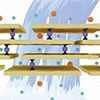
Schematic illustration of the ion intercalated dehydrated vermiculite membranes for Li+ extraction. (Image: Zhaoyu Ma / QIBEBT)
(click on image to enlarge)
|
Building an “Exclusive Channel” for Lithium Ions
|
|
The water-swelling resistance and stability of the deep-dehydrated vermiculite membrane provide a structural foundation for precise ion sieving. Due to the extremely narrow channels resulting from deep dehydration, larger hydrated Mg2+ ions with thicker hydration shells face high steric hindrance and a high transport barrier when attempting to enter the membrane.
|
|
Conversely, smaller lithium ions can smoothly enter the channels by deforming the shape of their hydration shells. Additionally, the Cs+ ions intercalated within the channels occupy the lowest-energy adsorption sites. This structural feature further lowers the energy barrier for lithium-ion transport within the channel.
|
|
Under optimized electrically driven permeation conditions, the membrane achieved a Li+ permeation rate of 0.65 mol m-2 h-1, while the lithium/magnesium separation selectivity reached 148.
|
Lithium Extraction Testing with Real Salt-Lake Bittern
|
|
To verify the application potential of this technology, the research team utilized complex bittern from a Qinghai salt lake for testing. In an integrated electrodialysis setup, following a single-step separation process, the Mg2+/Li+ ratio in the brine decreased from an initial 15.1 to 0.5, while the mass fraction of lithium ions increased from 6.1 wt% to 45.4 wt%.
|
|
Subsequently, through concentration and simple precipitation, industrial-grade lithium carbonate powder with a purity of 99.2% was obtained. When confronting the high osmotic pressure of salt-lake bittern, these extremely narrow membrane channels can effectively restrict the reverse permeation of water molecules, thereby reducing freshwater consumption.
|
|
Concurrently, during more than ten days of continuous operation, the membrane maintained stable separation performance with extremely low Cs+ leakage (less than 2 ppb).
|
|
This research offers a new perspective for solving the swelling problem of 2D layered membranes in aqueous solutions, while also providing a new paradigm for reducing the cost and energy consumption of extracting high-purity lithium salts from natural water bodies.
|
|
Source: Provided by Qingdao Institute of Bioenergy and Bioprocess Technology, Chinese Academy of Sciences
|
|
|