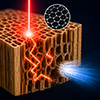
Porous wood and graphene create a light-trapping propellant that enables efficient laser ablation at unusually low continuous wave intensity.
(Nanowerk Spotlight) Light does not simply hit a material and stop. In a smooth, dense solid, much of it may reflect from the surface or heat a thin outer layer. In a porous solid, light can take a more complicated route. It can enter small channels, scatter from internal walls, and deposit heat below the surface. That hidden path can decide whether light becomes wasted glare, stored heat, or mechanical force.
That distinction matters when light must push on matter. In laser ablation propulsion, a beam heats a solid until a small amount of material ejects from the target. The escaping material produces recoil, and that recoil becomes thrust. The same laser-material interaction can be useful on Earth for machining, cleaning, micro-actuation, and laboratory impulse studies, but propulsion is most attractive in vacuum or near-vacuum environments, where small recoil forces are not overwhelmed by air drag and plume losses.
Most candidate propellants force a compromise. Metals can provide high specific impulse, which means efficient use of propellant mass, but they usually need very high laser intensities before ablation starts. Polymers ablate more easily, but they tend to consume more mass. Carbon materials absorb light well, yet dense carbon targets do not automatically provide low density, strength, and controlled ejection in the same package.
The researchers tested natural wood and graphene-delignified wood as propellants for continuous wave laser ablation, where the laser remains on rather than firing ultrashort pulses. The result was an unusually low-intensity ablation regime based on a material whose pores, cell walls, and optical absorption all contribute to propulsion.
Preparation of graphene-delignified wood (GDW), laser ablation propulsion (LAP) application, and comparison with common materials. (A) Illustration of the preparation of GDW composites. (B) Application as a propellant material for LAP in micro/nano satellites. (C) Radar plot comparing the performance of NW and GDW-25 with Al and Polytetrafluoroethylene (PTFE), in which the results are normalized by the maximum value of each characteristic. (Image: Reproduced from DOI:10.1002/advs.75463, CC BY) (click on image to enlarge)
Wood is central to the result because it already contains a useful internal structure. It has aligned channels, thin cell walls, and low density. Those features influence how light scatters, how heat spreads, and how ablated material escapes. The researchers did not treat wood as a novelty fuel. They treated it as a biological scaffold whose internal pathways could be tuned for light-driven recoil.
The modification began with delignification, a chemical treatment that removed part of the lignin and hemicellulose while preserving much of the cellulose framework. This changed the thickness of the cell walls and the openness of the pore network. The researchers then infused the shrunken structure with graphene and compressed it during drying, producing a denser composite with stronger internal bonding and higher optical absorption.
The most revealing result is that natural wood was already an exceptional propellant by one measure. It reached an absolute specific impulse of 907.74 s, higher than the graphene-delignified version. Because natural wood is so light, it also achieved the highest density-specific specific impulse in the study. That result prevents a simple story in which adding graphene automatically makes the material better.
The engineered wood solved a different part of the problem. Graphene-delignified wood reached a specific impulse of 800.49 s, while lowering the ablation threshold intensity to 0.54 MW m⁻². The paper reports this as the lowest threshold yet achieved for laser ablation propulsion. It also raised tensile strength to 273.1 MPa, about 10 times higher than natural wood under the tested conditions.
That split is the paper’s main design lesson. Natural wood delivers outstanding mass efficiency because of its low density and native porous structure. Graphene-delignified wood trades some of that density-specific advantage for a lower operating threshold, much higher strength, and a structure that researchers can tune. For a real propulsion material, the best choice may depend on whether the system needs maximum efficiency, lower laser power, or better mechanical robustness.
The mechanism follows the routes taken by light and escaping material. Delignification thins the cell walls, which reduces some internal scattering losses and helps confine light inside the structure. Graphene increases absorption, so more incoming energy becomes heat. Together, these changes help initiate ablation at lower intensity and reduce wasteful mass loss, which is essential for maintaining high specific impulse.
Porosity governs the recoil side of the process. Open internal pathways can guide vapor and fragments outward, improving the transfer of laser energy into directed momentum. The study found that moderate delignification favored stronger thrust and higher impulse coupling, while longer delignification favored higher specific impulse. In other words, the same material family can shift between force production and propellant efficiency by changing its cell wall architecture.
The laser damage patterns support that interpretation. Natural wood formed deeper craters after exposure, consistent with more localized removal. Graphene-delignified wood produced shallower craters over a broader affected area, pointing to more distributed heating and stronger light confinement. The surface did not merely burn away. The material’s internal geometry helped determine where energy accumulated and how recoil-producing material left the target.
The wood component also connects this propulsion result to broader work on engineered biological materials. Nanowerk previously reported on chemically modified wood that captures sunlight and stores energy, another example in which delignification and internal architecture control how a material handles light and heat. In the propulsion study, that same general principle becomes a way to tune thrust and propellant use.
The experiments remain a materials demonstration, not a spacecraft propulsion system. The researchers measured thrust in vacuum with a pendulum-based setup, but flight use would require proof that the target can operate repeatedly, shed material predictably, avoid harmful contamination, survive thermal cycling, and integrate with a realistic laser and power system. A low ablation threshold helps only if the whole subsystem can use it reliably.
The broader contribution is a design principle for laser ablation propulsion. Performance does not depend only on choosing a material that absorbs light or survives mechanical stress. It also depends on engineering the paths that light, heat, and ejected mass follow inside the target. Wood supplies an unusually useful starting architecture, while graphene and delignification tune it into a propellant that dense, uniform materials cannot easily match.
For authors and communications departmentsclick to open
Lay summary
Prefilled posts
Nanowerk Newsletter
Get our Nanotechnology Spotlight updates to your inbox!
Thank you!
You have successfully joined our subscriber list.
Become a Spotlight guest author! Join our large and growing group of guest contributors. Have you just published a scientific paper or have other exciting developments to share with the nanotechnology community? Here is how to publish on nanowerk.com.