DNA-barcoded probes let nanopores identify which metal-ion signals belong to which targets, enabling multiplexed sensing in water and soil extracts.
(Nanowerk Spotlight) In heavy metal sensing, the hardest signal is not always the weakest one. It is the one that cannot be assigned to the right metal. Environmental monitoring often needs to sort responses from lead, mercury, uranyl, zinc, manganese, calcium, and other dissolved species in the same sample. A sensor designed for one ion can be sensitive, but mixed water or soil extracts demand a way to tell which target produced each signal.
That identity problem limits many portable sensing strategies. A probe may respond strongly to lead or mercury, but multiplexed monitoring requires each response to remain traceable inside a mixed assay. Once several probes and several metal ions share the same sample, every recognition event needs a label that survives the measurement. Without that label, higher sensitivity still leaves the detector with signals that are difficult to assign.
For a nanopore sensor, the label has to travel with the molecule being measured. The detector reads one molecule at a time as it passes through a nanoscale opening, so identity and reaction state must appear in the same electrical trace. One feature must show which metal the probe was designed to recognize. Another must show whether that recognition event occurred.
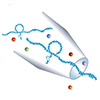
Each probe carries a DNAzyme nanoswitch that opens when a specific metal ion activates it, plus a DNA barcode that identifies the probe. As each molecule passes through the nanopore, the current trace contains both pieces of information: the probe’s identity and the switch’s reaction state.
The sensing platform uses DNA nanostructures that carry both a metal-specific trigger and a readable identity tag. Each probe includes a DNAzyme nanoswitch, which opens when its target metal ion activates it, and a short DNA barcode, which identifies which metal the probe was designed to detect. As the probe passes through a nanopore, these structural features create distinct changes in electrical current. The barcode tells the system which probe is being read, while the open or closed nanoswitch reports whether the target metal was present. (Image: Reproduced with permission from Wiley-VCH Verlag)
The nanopore does not identify lead, mercury, uranyl, calcium, manganese, or zinc directly. It reads labeled DNA reporters. The barcode says which metal the reporter represents, and the open or closed nanoswitch says whether recognition occurred. With that design, the researchers distinguished six metal-ion probes in one assay, detected lead down to 1 pM, and tested the approach in lake water and soil extracts.
Nanopore sensing gives the system its electrical readout. A voltage drives molecules through a tiny pore in a membrane. Each molecule partly blocks the ionic current as it passes through. The resulting current blockade can reveal structural features of the molecule, which makes nanopores useful for reading designed DNA shapes without fluorescent labels.
The researchers used that capability to read DNA structures as both identifiers and sensors. One region of each DNA probe contains the barcode. Small DNA features create a pattern in the current trace, allowing the event to be assigned to a probe class. Another region contains the metal-responsive nanoswitch. The two regions remain part of the same molecule, so identity and response stay linked during measurement.
The recognition element relies on DNAzymes, DNA sequences that catalyze reactions when a particular metal ion helps activate them. In the closed state, the DNAzyme nanoswitch adds an extra current drop during nanopore passage. When the target metal activates the DNAzyme, the switch cleaves at a designed site and opens. The extra current drop then disappears, changing the electrical signature from closed to open.
The assay turns that structural change into a countable signal. The researchers classified many single-molecule events by barcode, then calculated the fraction of each class that appeared open. A higher open percentage indicated more target-triggered cleavage. This approach separates two tasks that often become entangled in multiplexed sensing: the barcode assigns identity, while the nanoswitch reports chemical activation.
The first experimental question was whether the switch could report recognition with enough sensitivity. A lead-responsive probe showed the expected closed-switch feature in control samples. After exposure to lead, most events lost that secondary signal, consistent with cleavage and opening. Under optimized conditions, the platform detected lead at 1 pM, showing how DNAzyme catalysis and single-molecule counting can support ultratrace measurement.
The next question was whether metal selectivity survived inside the nanopore workflow. A lead-responsive DNAzyme probe reacted strongly to lead while remaining close to control levels for magnesium, uranyl, calcium, manganese, zinc, and mercury. A separate uranyl-responsive probe showed the corresponding preference for uranyl ions. These tests showed that the switch could preserve target discrimination before the researchers added barcode-based multiplexing.
The barcode layer then allowed multiple probes to share one measurement. The researchers assigned different DNA barcodes to probes for lead, mercury, uranyl, calcium, manganese, and zinc. The library included toxicologically important targets such as lead, mercury, and uranyl, along with calcium, manganese, and zinc to test broader metal-ion programmability. In mixed assays, the nanopore traces still identified each probe class.
That design avoided the need for the pore itself to produce a unique metal-specific signal. Nanopores have previously been used to read designed DNA structures as electrical barcodes, including in work on solid-state nanopore reading of DNA nanostructure barcodes. Here, the encoded DNA structures serve a chemical purpose. They label which metal-responsive probe has reacted.
The multiplexed tests showed why that matters. When all six target ions were present, the corresponding probe classes showed increased open percentages. When lead and calcium were omitted from the mixture, those two probe classes stayed near control levels while the others responded. The result showed that the platform could sort positive and negative recognition events within the same stream of nanopore data.
The researchers then moved to lake water, where dissolved salts, organic matter, and particles can interfere with sensing. They filtered the water to reduce pore-clogging material, diluted it, incubated it with the six-probe library, and measured the sample. The workflow took less than 1 h. In this demonstration, the assay produced positive responses for calcium, uranyl, manganese, and zinc probes, while lead and mercury probes remained near control levels.
Laboratory comparison supported those assignments. Inductively coupled plasma mass spectrometry, or ICP-MS, gave qualitatively consistent results for the same lake-water sample. Spike-and-recovery tests for lead fell within the accepted 80 % to 120 % range, and matrix-matched calibration gave a lead limit of quantification of 36.8 pM. These results support the nanopore assay in that matrix, but they do not make it a replacement for full laboratory analysis.
Soil extracts tested a different source of complexity because metals can bind to solids and organic matter before extraction. After acid digestion, filtration, and probe incubation, the nanopore assay produced positive responses for lead, uranyl, manganese, and zinc probes in brown soil extract. Calcium and mercury did not show significant positive responses in that sample. ICP-MS again supported the nanopore result, and lead spike recovery reached 113 %.
The platform still depends on several conditions that matter for real deployment. Each new target needs a DNAzyme or related recognition element that remains selective in the intended sample chemistry. The hardware also needs robust nanopores, stable probes, controlled incubation, automated handling, and reliable event classification. Work on programmable nanopores for DNA detection shows how much engineering can stand between a molecular sensing concept and routine use.
The broader implication is a modular sensing library. Change the DNAzyme to change the target, change the barcode to preserve identity, and keep the nanopore readout conceptually constant. The paper should therefore be read as a proof of concept for digitally addressed chemical sensing, not as a finished field monitor. Its value lies in making faint metal-ion signals traceable, one labeled DNA molecule at a time.
For authors and communications departmentsclick to open
Lay summary
Prefilled posts
Nanowerk Newsletter
Get our Nanotechnology Spotlight updates to your inbox!
Thank you!
You have successfully joined our subscriber list.
Become a Spotlight guest author! Join our large and growing group of guest contributors. Have you just published a scientific paper or have other exciting developments to share with the nanotechnology community? Here is how to publish on nanowerk.com.