| May 09, 2026 |
A photoisomeric molecule called BTTM anchors ions in perovskite solar cells, improving UV stability and raising efficiency from 22.07% to 24.71%.
|
|
(Nanowerk News) Researchers at Northwestern Polytechnical University and collaborating institutions have reported a molecular additive that protects perovskite solar cells from ultraviolet damage while raising their efficiency.
|
|
The work, led by Wenying Zhao and Yongguang Tu, was published in the journal Research (“Photoisomeric Molecule-Mediated Ion Anchoring and UV Resistance in Metal Halide Perovskites”). It describes how a light-responsive compound called BTTM, embedded inside the perovskite layer itself, anchors mobile ions and stabilizes the crystal lattice during UV exposure. The approach addresses a stubborn durability problem for perovskite photovoltaics.
|
Key Findings
- BTTM-modified perovskite solar cells reached a power conversion efficiency of 24.71%, up from 22.07% in untreated control devices.
- After cumulative UV exposure of 5 kWh/m², treated cells retained around 90% of their initial efficiency, while control cells held only about 60%.
- The additive stabilizes the perovskite by coordinating with lead through carbonyl groups and hydrogen-bonding to iodide through N–H groups, suppressing ion migration.
|
|
Sunlight itself can damage perovskite solar cells. High-energy ultraviolet photons oxidize halide ions, accelerate iodide migration, drive component loss, and create deep electronic defects, all of which degrade device performance over time. Most existing solutions try to filter UV light from outside the device. The Northwestern Polytechnical team took a different route by working from within the absorber layer.
|
|
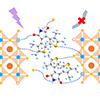
The team built the additive into metal halide perovskite films using 2,3-bis(2,4,5-trimethyl-3-thienyl) maleimide, abbreviated BTTM. Unlike a passive dopant, BTTM is photoisomeric, switching reversibly between two structural conformations when hit by ultraviolet or visible light. Coupled with the chemical bonds it forms with the perovskite lattice, that switching behavior lets the molecule pin mobile ions in place and damp the structural changes that UV exposure would otherwise drive.
|
|
Ion anchoring sits at the core of the mechanism. The carbonyl groups on BTTM coordinate directly with lead atoms in the perovskite lattice, and the N–H groups form hydrogen bonds with iodide. Those two attachments hold the lead-iodide octahedral framework together, heal point defects in the structure, and block iodide ions from drifting. Without that anchoring, UV photons drive iodide oxidation and iodine release, which then opens vacancies, depletes perovskite components, and breaks down the crystal lattice.
|
|
Beyond UV protection, BTTM reshaped the film itself. At the optimized loading, the perovskite layers grew with larger grains and more uniform crystal orientation, contained less residual PbI₂, and presented smoother surface morphology. Films also carried lower tensile stress, emitted brighter photoluminescence, and supported longer carrier lifetimes, rising from 126.41 to 340.82 nanoseconds. The longer lifetime indicates reduced nonradiative recombination and helps account for the gains in open-circuit voltage and overall device output.
|
|
The gap between treated and untreated films widened sharply under UV aging. Control films gave off iodine, dimmed in photoluminescence, formed PbI₂, suffered crystal damage, and showed shifts in surface potential. BTTM films held their optical emission, kept their crystalline structure largely intact, and maintained even morphology. Electrical characterization reflected the same pattern, with less hysteresis and lower dark current both pointing to reduced ion movement and fewer recombination losses.
|
|
Performance numbers reinforced the structural results. The optimized BTTM cell reached a power conversion efficiency of 24.71%, against 22.07% for the unmodified control, and stabilized output settled at 24.12%. The same approach also improved performance in wide-bandgap perovskite devices.
|
|
Stability testing followed a similar pattern. In nitrogen storage, unencapsulated BTTM cells held 96.9% of their starting efficiency after 1,000 hours, compared with 54.3% for control devices. Under cumulative UV irradiation of 5 kWh/m², BTTM devices retained roughly 90% of their initial efficiency, while unmodified devices fell to about 60%.
|
|
The authors caution that the work does not close out every long-term stability question for perovskite photovoltaics. Real-world deployment subjects cells to heat, humidity, oxygen exposure, mechanical loading, and the full solar spectrum at once, and the additive strategy still needs validation in encapsulated modules under those conditions. The narrower contribution lies in UV resistance, where combining defect passivation, ion anchoring, and a light-responsive molecule gives engineers a clearer design template for perovskite cells aimed at high-UV environments.
|