Heavy water’s stronger hydrogen-bond network lowers ion desolvation energy in a zinc-copper Daniell cell, enabling uniform metal deposition and over 2,500 rechargeable cycles from a 190-year-old design.
(Nanowerk Spotlight) Every chemistry student meets the Daniell cell. A strip of zinc in one beaker, a strip of copper in another, a salt bridge between them, and the voltmeter needle swings. John Frederic Daniell built the first one in 1836, and within a decade it was powering telegraph lines across continents.
On paper, the design looks almost ideal for modern grid-scale energy storage: both electrode metals are cheap and abundant, the electrolyte is water, and nothing in the system is flammable or toxic. But once spent, a Daniell cell cannot be recharged. That limitation has held for nearly 190 years.
The obstacle is the very thing that makes the battery work. Water carries ions between the two electrodes, but it also corrodes them, generates hydrogen gas, and deposits insulating copper oxide on surfaces meant to stay clean. Over repeated cycles these losses compound and the cell quickly fails. Concentrated salts, membrane separators, and electrolyte additives have each addressed one failure mode or another, but water’s reactivity is not a single problem with a single fix.
Researchers in China have now taken a different approach: they changed the water. By substituting heavy water, in which every hydrogen atom carries one extra neutron, they turned Daniell’s 19th-century design into a rechargeable cell that survived more than 2,500 charge-discharge cycles.
That extra nuclear mass lowers the vibrational energy of each molecular bond and pulls neighboring D₂O molecules into a tighter, more ordered arrangement. This structural resilience persists even under the electric fields present during battery operation, conditions that begin to unravel the weaker hydrogen-bond network in ordinary water.
The tighter network reshapes a critical step in metal electrodeposition. Zinc and copper ions in aqueous electrolytes travel wrapped in shells of water molecules. Before an ion can deposit as solid metal on an electrode, this solvation shell must break apart. The energy required for that step, called the desolvation energy, governs both the speed and the uniformity of deposition.
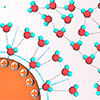
Proposed solvent isotope mechanism for improved metal electrodeposition in D₂O-based electrolytes. The stronger hydrogen/deuterium-bond network in D₂O weakens ion–solvent interactions around hydrated metal cations, lowering the desolvation energy barrier and accelerating charge transfer at the electrode interface. This promotes dense nucleation and uniform metal deposition while reducing parasitic water-involved reactions, thereby improving the reversibility and cycling stability of Zn/Cu electrodes. (Image: Adapted with permission from Wiley-VCH Verlag) (click on image to enlarge)
The team’s computational work showed that desolvation energy drops consistently in D₂O. Because D₂O molecules bind more strongly to each other, they bind less strongly to metal ions, releasing them more readily at the electrode surface. The effect proved general across multiple metal ions, including copper, zinc, manganese, and aluminum.
The consequences for copper deposition were stark. In D₂O electrolytes, copper nucleated as small, evenly distributed particles that merged into a dense, continuous layer covering the entire electrode. In ordinary water, copper grew into large, irregular octahedral crystals contaminated with Cu₂O. Pure metallic copper formed only in the heavy water system, while H₂O consistently produced parasitic oxide byproducts.
Electrochemical measurements isolated the source of this advantage. In three-electrode cells, which separate interfacial reactions from bulk ion transport, the D₂O system required far less driving voltage to initiate copper deposition. Its Tafel slope fell below half that of the H₂O system, confirming that charge transfer at the electrode surface proceeds faster when the solvation shell is easier to shed.
D₂O does exact a cost. Its higher viscosity slows ion diffusion through the bulk electrolyte, raising the overall voltage needed to drive the reaction. Faster desolvation at the interface and slower mass transport in the bulk pull in opposite directions. Under normal battery operating conditions, though, desolvation is the rate-limiting step, and heavy water’s advantage at the interface outweighs its penalty in the bulk.
Heavy water also starved the parasitic reactions that destroy aqueous batteries from within. Hydrogen evolution rates fell by more than five times. Oxygen evolution shifted to higher potentials. Real-time mass spectrometry during copper deposition confirmed far less gas generation in D₂O, direct evidence that heavy water suppresses the side reactions responsible for electrolyte loss and electrode degradation.
The combined effect on electrode lifespan was enormous. Copper electrodes in D₂O achieved average Coulombic efficiencies of 99.8% and operated stably for over 3,500 hours. Zinc electrodes reached 99.7% efficiency with lifespans exceeding 3,000 hours. In H₂O, copper electrodes lasted less than 500 hours before failing, and zinc electrodes suffered rapid degradation marked by wild voltage swings.
Full zinc-copper rechargeable cells, assembled with polyacrylamide gel electrolytes and an anion exchange membrane to block copper ion crossover, confirmed the half-cell results. D₂O-based cells ran stably for over 800 hours at low current density and exceeded 2,500 cycles under voltage-cutoff testing with Coulombic efficiencies above 99%. H₂O-based cells failed within 200 cycles.
The underlying mechanism inverts the conventional kinetic isotope effect. In most reactions, substituting deuterium for hydrogen slows bond-breaking steps because the heavier atom vibrates more sluggishly. Here the rate-limiting process is not bond cleavage but reorganization of the solvation shell. A tighter hydrogen-bond network tips the competition between water-water and water-ion interactions in favor of releasing the ion, so the heavier isotope accelerates the electrode reaction rather than retarding it.
The cost analysis in the paper estimates that D₂O-based zinc-copper batteries could reach roughly $0.07 per mAh when their extended cycle life is accounted for, below the cost of conventional H₂O equivalents. The approach offers a broad design principle for aqueous rechargeable metal batteries: rather than engineering around water’s reactivity, change the water itself.
For authors and communications departmentsclick to open
Lay summary
Prefilled posts
Nanowerk Newsletter
Get our Nanotechnology Spotlight updates to your inbox!
Thank you!
You have successfully joined our subscriber list.
Become a Spotlight guest author! Join our large and growing group of guest contributors. Have you just published a scientific paper or have other exciting developments to share with the nanotechnology community? Here is how to publish on nanowerk.com.