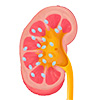
Light-driven antioxidant nanomotors help reach injured kidney tissue and reduce the damage that allows kidney stone crystals to attach.
(Nanowerk Spotlight) Kidney stones become a clinical problem when hard crystals grow large enough to cause pain, obstruction, or infection. By that stage, treatment often focuses on removing or breaking the stone. Preventing stones means intervening before crystals firmly attach to the kidney lining. The first attachment sites form on microscopic tubular surfaces that are constantly washed by flowing urine.
The most common stones contain crystals made from calcium and oxalate, a small molecule found in many foods and also produced by the body. When oxalate builds up, it can injure the cells that line kidney tubules. Those cells generate reactive oxygen species, chemically aggressive molecules that drive oxidative stress, and display more surface signals that help crystals attach. Prevention at this stage depends on protecting the tubular lining, not just managing mineral crystals.
Protecting that lining creates a delivery problem. The target is not a large stone, but scattered patches of stressed cells inside an organ that constantly filters blood and moves fluid. A useful therapy must reach those cells in sufficient amounts, remain there long enough to act, and avoid harming healthy kidney tissue. Targeted nanoparticles offer one route, but many still depend mostly on circulation and chance encounters with the right cells.
A study in Advanced Functional Materials (“Near‑Infrared Driven Renal Nanomotors for Oxidative‑Stress Relief and Stone Prevention”) applies this active-transport concept to kidney stone prevention. The work reports near-infrared driven antioxidant nanomotors that accumulate more efficiently in injured renal tissue. The goal is not to heat or break stones. It is to deliver protective particles to tubular cells where oxalate injury makes crystals more likely to attach and persist.
Schematic illustration of the synthesis and therapeutic mechanism of the designed PDA@PPy@HA nanomotors for calcium oxalate crystal-induced kidney injury. (Image: Reproduced with permission from Wiley-VCH Verlag) (click on image to enlarge)
The nanomotor, called PDA@PPy@HA or PYA, combines targeting, movement, and antioxidant chemistry in one particle. Polydopamine forms the core and supplies chemical groups that neutralize reactive oxygen species. Polypyrrole helps the particle absorb near-infrared light and move under irradiation. Hyaluronic acid forms the outer layer and binds CD44, a receptor that rises on damaged tubular cells in stone-forming conditions.
Those functions matter because none is sufficient alone. Targeting without movement can still leave too little material at the injured site. Motion without antioxidant chemistry would not address oxalate-driven cellular stress. Antioxidant particles without targeting risk dilution across the body. PYA brings these roles together so that light can improve delivery while the particle surface acts on the oxidative injury that favors crystal retention.
Under low-power 808 nm irradiation, PYA generated mild heating near 35 °C, enough to support propulsion without reaching the high temperatures used in tissue-ablation therapies. Without light, the particles mainly showed random Brownian motion. With near-infrared irradiation, they moved directionally, reaching speeds up to 201 µm/s in water as a benchmark. They slowed in more complex fluids, including urea solution and blood, but still showed guided movement.
The first biological tests used HK-2 cells, a human kidney tubular cell model. Oxalate exposure injured the cells, increased reactive oxygen species, and weakened mitochondrial membrane potential, a measure of whether mitochondria can maintain the electrical imbalance they need to function. PYA treatment reduced oxidative stress, helped restore mitochondrial function, and improved cell viability. Near-infrared irradiation increased particle uptake without adding measurable toxicity under the tested conditions.
These cell results connect delivery to the earliest steps of stone retention. Stressed tubular cells display more adhesion-related molecules, including CD44 and osteopontin. These signals make the kidney surface more favorable for calcium oxalate crystals to stick. PYA therefore works upstream of stone growth. It reduces the cellular damage that can turn a passing crystal into an attached deposit.
The mouse experiments tested whether active delivery improved treatment in living kidneys. In a glyoxylate-induced model of calcium oxalate deposition, fluorescently labeled PYA reached the kidneys after intravenous injection. When the renal region received near-infrared light, kidney accumulation increased compared with nonirradiated treatment. Other major organs did not show the same light-linked increase, supporting the claim that propulsion improved renal enrichment.
The added accumulation produced stronger protection. PYA reduced calcium oxalate crystal deposition in kidney tissue, and near-infrared activation produced the clearest reduction. Treated mice showed less tubular injury and fewer dying epithelial cells. Blood markers of kidney function, including creatinine and blood urea nitrogen, also improved compared with untreated diseased mice. The therapeutic effect therefore followed the improvement in delivery, not particle chemistry alone.
The molecular evidence supported the same sequence. In diseased kidneys, antioxidant defenses declined while oxidative and adhesion-related signals increased. PYA treatment raised antioxidant enzymes, including catalase and superoxide dismutase 2, and lowered NOX2, an enzyme linked to reactive oxygen species production. It also reduced osteopontin and CD44. Near-infrared activation strengthened these changes, consistent with higher particle accumulation at injured renal tissue.
This distinction separates the platform from light-based treatments that use heat as the main therapeutic force. Here, light primarily serves as a navigation tool. The therapeutic action comes from redox regulation and reduced adhesion signaling. The approach fits a wider movement in biomolecular nanomotors for precision medicine, where nanoscale systems seek to overcome the limits of passive delivery.
Related active-particle studies have used motion to address difficult biological targets, including near-infrared nanomotors for biofilm removal and light-driven nanomotors that clear blood clots. The kidney-stone study differs because it does not use motion mainly to attack a visible obstruction. It uses motion to enrich antioxidant particles at stressed tissue before mineral deposits become the dominant therapeutic target.
Early safety results were favorable but limited. PYA caused less than 5 % hemolysis in blood compatibility tests and showed little toxicity to kidney epithelial cells within the tested concentration range. In mice, repeated dosing over 7 days did not significantly alter liver or kidney biochemical markers. Major organ histology did not reveal obvious tissue damage, but chronic and recurrent stone disease will require longer safety studies.
Several practical questions remain. The particles are about 200 nm across, and smaller versions may move through renal structures more effectively while preserving propulsion and antioxidant activity. Human kidney stones also develop through repeated interactions among urine chemistry, hydration, diet, genetics, inflammation, and tissue injury. The mouse model captures important parts of calcium oxalate deposition, but it cannot resolve all translational questions.
The study’s main contribution is a shift in emphasis from the stone to the tissue that lets stones take hold. By combining CD44 recognition, light-driven movement, and reactive oxygen species scavenging, PYA nanomotors show that delivery can be part of the therapeutic mechanism. For early kidney stone prevention, reaching the stressed tubular lining may matter as much as the antioxidant chemistry carried there.
For authors and communications departmentsclick to open
Lay summary
Prefilled posts
Nanowerk Newsletter
Get our Nanotechnology Spotlight updates to your inbox!
Thank you!
You have successfully joined our subscriber list.
Become a Spotlight guest author! Join our large and growing group of guest contributors. Have you just published a scientific paper or have other exciting developments to share with the nanotechnology community? Here is how to publish on nanowerk.com.