| Apr 30, 2026 |
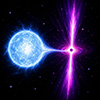
The LHAASO observatory has detected gamma rays above 100 TeV from a gamma-ray binary for the first time, challenging current models of cosmic particle acceleration.
|
|
(Nanowerk News) The Large High Altitude Air Shower Observatory (LHAASO) collaboration has detected ultra-high-energy gamma rays from a gamma-ray binary for the first time, picking up photons above 100 trillion electron-volts (TeV) from the source LS I +61° 303. The result, reported by an international team led from the Chinese Academy of Sciences, challenges current models of how particles are accelerated in extreme cosmic environments.
|
Key Findings
- The collaboration measured photons up to 200 TeV from LS I +61° 303, the first time ultra-high-energy gamma rays have been seen from a gamma-ray binary.
- The brightness of the emission varies with the system’s 26.5-day orbital period, and the variation depends on photon energy.
- Photons above 100 TeV point to high-energy protons, rather than electrons, as the source of the most energetic emission.
|
|
The findings appear in Physical Review Letters (“First detection of ultrahigh energy emission from gamma-ray binary LS I +61° 303”), where the paper was selected as an Editor’s Suggestion and featured as a Synopsis by Physics Magazine. Researchers from the Institute of High Energy Physics (IHEP) at the Chinese Academy of Sciences (CAS) led the analysis, working with collaborators from the Shanghai Astronomical Observatory of CAS and other institutions.
|
|
The origin of high-energy cosmic rays has remained an open question in astrophysics for nearly a century. Identifying the accelerators that drive charged particles to peta-electron-volt energies, or 1,000 trillion electron-volts, is central to solving it. Such sources are known as PeVatrons, and only a small number of credible candidates have been pinned down so far.
|
|
Gamma-ray binaries are one possible class of accelerator. These systems pair a massive star with a compact object, either a neutron star or a stellar-mass black hole, and they serve as natural laboratories for extreme physics. Only a handful are known to produce very-high-energy gamma rays above 0.1 TeV, and until now none had been seen in the ultra-high-energy range.
|
|
LS I +61° 303 is a classical gamma-ray binary that earlier instruments had observed up to about 10 TeV. Whether it could produce higher-energy photons was unknown. Drawing on LHAASO’s sensitivity and broad energy coverage, the collaboration extended the measured spectrum to 200 TeV, confirming LS I +61° 303 as the first ultra-high-energy gamma-ray binary.
|
|
The team also tracked how the gamma-ray flux changes over the 26.5-day orbital period of the system. The variation depends on photon energy, indicating that different physical processes dominate at different orbital phases. Mapping this energy-dependent modulation lets observers probe the acceleration and radiation mechanisms operating inside the binary.
|
|
The detected energies place a tight physical constraint on what is producing them. Strong magnetic fields inside binary systems cause high-energy electrons to lose energy rapidly through synchrotron radiation, preventing electrons from reaching the ultra-high-energy range. Photons above 100 TeV therefore indicate that high-energy protons are being accelerated during specific orbital phases and colliding with the dense stellar wind around the massive star to produce the observed emission.
|
|
If protons are responsible, LS I +61° 303 belongs to the candidate PeVatron population, capable of pushing cosmic rays to peta-electron-volt energies. The measurement imposes new, stringent constraints on theoretical models of particle acceleration and radiation in extreme astrophysical environments, and it strengthens the case for gamma-ray binaries as targets in multi-messenger astronomy, which combines electromagnetic and non-electromagnetic signals.
|
|
The detection broadens the sample of known ultra-high-energy sources and gives theorists a concrete laboratory for testing how protons reach extreme energies inside compact stellar systems.
|