| Apr 24, 2026 |
Researchers developed a 2D metal-organic framework that works as a single all-in-one cocatalyst for photocatalytic water splitting, simplifying clean hydrogen fuel production from sunlight.
|
|
(Nanowerk News) Researchers have demonstrated the first “all-in-one” cocatalyst for photocatalytic overall water splitting (OWS), a breakthrough that could simplify the production of clean hydrogen fuel. The discovery marks an important step toward practical technologies that use sunlight and water to generate hydrogen, a key energy carrier expected to play a major role in building a decarbonized and sustainable society.
|
|
Details of the researchers’ findings were published in the journal Nature Chemistry (“Two-dimensional metal–organic frameworks offer all-in-one cocatalysts for photocatalytic overall water splitting”).
|
 |
| Schematic illustration on photocatalytic overall water splitting. (Image: Tohoku University)
|
|
Hydrogen is widely regarded as a promising clean energy source because it produces only water when used as fuel. Among the various methods for producing hydrogen, photocatalytic overall water splitting – using sunlight to split water into hydrogen and oxygen – has attracted increasing attention as an environmentally friendly and sustainable approach.
|
|
In photocatalytic systems, a photocatalyst absorbs light energy and drives the chemical reactions needed to split water. However, the two key reactions involved – the hydrogen evolution reaction and the oxygen evolution reaction – are often slow on the photocatalyst surface. To improve efficiency, researchers typically modify photocatalysts with cocatalysts that help promote these reactions.
|
|
Conventional photocatalytic systems are complex. Separate cocatalysts are usually required to promote hydrogen and oxygen evolution, and they must be carefully positioned on the photocatalyst surface. In addition, an oxygen-blocking layer is often added to prevent reverse reactions that reduce oxygen and lower overall efficiency. These complicated structures make large-scale production and long-term operation more challenging.
|
|
To overcome these limitations, scientists have long sought an “all-in-one” cocatalyst – a single material capable of promoting both hydrogen and oxygen evolution reactions while preventing the unwanted reverse reaction. Until now, such a system had not been achieved because most cocatalysts have been limited to metals and metal oxides designed to promote only one type of reaction.
|
 |
| (a) OWS photocatalytic system using existing cocatalysts, and (b) OWS photocatalytic system using the all-in-one cocatalyst pursued in this study. (Image: Tohoku University)
|
|
The researchers modified the surface of an aluminum-doped strontium titanate photocatalyst (SrTiO₃:Al) with nanodomains of Co-HHTP using a simple one-step self-assembly method. The resulting material achieved stable overall water splitting without the need for an additional oxygen-blocking layer and demonstrated an apparent quantum efficiency of 31.5% at a wavelength of 350 nanometers.
|
|
“This work shows that a single material can efficiently promote both hydrogen and oxygen evolution while suppressing the reverse reaction,” said Sakamoto. “By simplifying the cocatalyst design, we hope this concept will help accelerate the development of practical technologies for producing clean hydrogen from sunlight and water.”
|
|
Beyond the performance results, the study introduces a new scientific concept in photocatalysis. The team demonstrated how conductive two-dimensional metal-organic frameworks, with properties such as electrical conductivity, molecularly defined structures that control reaction selectivity, and intrinsic porosity, can be rationally designed to perform multiple catalytic roles in a single material.
|
 |
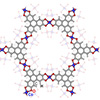
| Co-HHTP, a type of conductive 2D-MOF. (a) Chemical structure of the 2D-MOF layer of Co-HHTP. (b) Stacking structure of Co-HHTP (Image: Tohoku University)
|
|
The findings also provide promising insights for real-world applications. The all-in-one cocatalyst uses inexpensive metal ions and organic ligands and avoids precious metals or toxic chromium often used in conventional systems. Combined with its simple one-step fabrication method, this new “all-in-one cocatalyst” paradigm could help advance practical technologies for sustainable hydrogen production and contribute to the realization of a future hydrogen society.
|