| Apr 20, 2026 |
A new study reveals how a spinning vortex causes system-wide, counter-rotating wave patterns, mimicking effects that occur, but cannot be seen, in the quantum realm.
(Nanowerk News) In the quirky, quantum world, particles can be affected by forces that they never directly encounter. A classic example is the Aharonov–Bohm (AB) effect, where electrons are affected by a magnetic field, despite not passing through it. Although predicted in 1959, it took more than two decades to confirm this effect experimentally, as the specific changes to the electrons’ wave properties could only be inferred indirectly, and with great difficulty.
|
|
Now, physicists from the Okinawa Institute of Science and Technology (OIST), in collaboration with the University of Oslo and Universidad Adolfo Ibáñez, have used a classical fluid analogue that mimics and extends the AB effect using a simple platform: a water tank.
|
|
Published today in Communications Physics (“Topology made visible through standing waves in a spinning fluid”), the researchers have revealed that when water waves are sent towards a swirling vortex from opposite directions, it causes a striking pattern, with one or more lines of momentarily still water radiating outward and rotating in an almost hypnotic way.
|
|
|
|
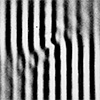
Lines of momentarily flat water extend outward and rotate, in the opposite direction to the flow of the vortex. The left video shows the pattern from the experiment, while the right video shows the same effect in a simulation model.
|
|
“This was something new and unexpected,” says Aditya Singh, a PhD student in the Nonlinear and Non-equilibrium Physics Unit and co-first author of the study. “That’s what makes this fluid analogue system so valuable. It reveals topological effects — wave behaviors that occur across the whole system — that can’t be seen in quantum experiments.”
|
The beginnings with Berry
|
|
The team’s inspiration for this research traces back to a 1980 study by theoretical physicist Michael Berry, who first showed that the AB effect could be simulated in a classical fluid system. In the quantum version, electrons pass around a tightly coiled wire, called a solenoid. When an electric current flows through the solenoid, this generates a magnetic field that’s confined within the coil. However, electrons passing outside the solenoid, where the magnetic field is zero, are still affected, with their wave shifting in phase.
|
|
In Berry’s experiment, a vortex forming at the drain of a tank stood in for the solenoid. Instead of electrons, Berry caused water waves to travel across his tank, passing around the vortex rather than through it. The travelling waves developed a distinctive distortion — a pitchfork-like pattern centered on the vortex — marking a shift in their phase.
|
|
“With waves travelling the opposite direction, you see a mirror image pattern,” adds Jonas Rønning, co-first author and former postdoc in the OIST unit. “The question for us was: what happens if you send waves from both directions at the same time? We thought that the patterns might cancel each other out, or both pitchfork-like patterns would be visible, but our intuition was completely wrong.”
|
|
|
|
As waves travel past the vortex, they distort and form pitchfork-like patterns, that are localized around the central vortex. When the direction of the waves is changed (arrow direction), the distortion pattern is mirrored. The top two sections show simulated patterns while the bottom two sections show the patterns seen in the experiments.
|
From travelling to standing waves
|
|
In their experiment, the researchers created a vortex at the center of a large, custom-built water tank and generated waves from opposite sides of the tank so that they met and interfered. By illuminating the water’s surface from beneath and recording with a high-speed camera, the team could track how the wave pattern across the whole tank changed over time.
|
|
Under conditions without a vortex, when opposing waves meet and interfere, this results in a predictable standing wave pattern where waves appear to be fixed in place. These patterns contain stationary lines, known as wavefronts, where the waves have the same phase.
|
|
But adding a vortex gives an unexpected twist. As the vortex causes shifts in the wave phase, this changes how the standing waves interfere with each other, resulting in rotating lines where the wave height is zero, called nodal lines.
|
|
“When we first saw these lines, we thought they were an experimental artefact,” says Singh. “But when we also saw them in our simulations, we dropped everything and quickly worked out the mathematics underlying how they arise.”
|
|
These nodal lines exhibit interesting behaviors, always rotating in the opposite direction to the vortex, and increasing in number as the researchers increased the vortex’s flow.
|
|
|
|
In both simulations (above) and experiments (below), the number of rotating nodal lines increases with a faster vortex flow. At lower flow (left), only one nodal line is seen, whilst at a higher flow (right), two nodal lines appear.
|
|
At such an early stage of discovery, it’s unclear whether these nodal lines could have useful applications. But for the unit head and senior author, Professor Mahesh Bandi, the real draw is the limitless avenues now open for future research using their classical analogue system.
|
|
“One direction is to make the system more complex by introducing multiple vortices and arranging them into a lattice,” says Bandi. “That setup would mirror conditions in some superconducting materials, with the water waves behaving like a supercurrent. We don’t yet know what we’ll see — and that’s exactly what makes it worth doing.”
|
|
More broadly, the team’s findings highlight the power of simple classical analogues to reveal new understanding about the quantum world. “Theorists might predict these effects, but quantum experiments wouldn’t see them,” he says. “With analogues like this, we can.”
|