Two curated guides review 67 free AI and computational tools for your daily work in the lab, from literature discovery and academic writing to DFT and ML potentials.
(Nanowerk Spotlight) Two years ago, a researcher’s free artificial intelligence (AI) toolkit was basically Google Scholar and Zotero. Today there are hundreds of options: AI assistants that summarize papers in seconds, citation managers that flag contradicted findings automatically, machine learning potentials that simulate atomic forces across most of the periodic table at a fraction of the cost of traditional DFT. But most scientists simply do not have time to test them all.
We put together two curated guides that cover the entire research workflow, one for scientists in any discipline, one specifically for materials science and nanotechnology. Between them, they review 67 free tools and calculators for students and scientists, each verified as active and available as of April 2026, with free-tier limitations fully documented.
This guide reviews AI-powered tools across six research workflow stages: literature discovery, note-taking and knowledge management, academic writing, citation management, data analysis, and creating graphical abstracts.
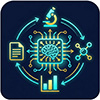
Research lifecycle. (Image: Nanowerk)
Among the highlights: Elicit builds structured comparison tables that extract sample sizes, methodologies, and outcomes across dozens of papers, making it particularly useful for systematic reviews. ResearchRabbit maps citation networks visually to surface relevant work that keyword searches miss. And NotebookLM lets you upload up to 50 sources and query them conversationally, including YouTube lecture videos.
The guide also tackles data privacy head-on. Several of these tools process uploads through cloud-based models, and some free tiers use your data for training by default. For researchers handling unpublished or sensitive work, we include a privacy-first stack built entirely around local-first tools: Semantic Scholar for discovery, Obsidian for notes, Zotero for citations. Nothing leaves your machine.
The second guide covers more than 30 open-source tools and 16 online calculators across ten categories, from materials databases and DFT codes to characterization analysis and thin-film fabrication tools.
Research workflow. (Image: Nanowerk)
The tools are organized by research workflow: the Materials Project for structures and reference data, ASE and pymatgen as Python glue layers, Quantum ESPRESSO or CP2K for DFT calculations, and AiiDA to orchestrate everything when you scale to high-throughput screening. The guide also covers universal machine learning interatomic potentials like MACE-MP-0 and CHGNet, which are making near-DFT-accuracy molecular dynamics accessible without supercomputer access.
For experimentalists, the guide includes GSAS-II for XRD refinement, HyperSpy for electron microscopy, and quick online calculators for Scherrer crystallite sizing, Bragg’s law d-spacing, and Williamson-Hall strain analysis. Three recommended starter stacks, tailored to computational PhD students, experimentalists, and ML-for-materials researchers, help you find your entry point without wading through all the options first.
Get our Nanotechnology Spotlight updates to your inbox!
Thank you!
You have successfully joined our subscriber list.
Become a Spotlight guest author! Join our large and growing group of guest contributors. Have you just published a scientific paper or have other exciting developments to share with the nanotechnology community? Here is how to publish on nanowerk.com.