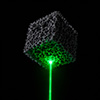
Parabolic flight tests reveal that gravity had been masking nearly all of graphene aerogel’s light-driven propulsive capability in every prior experiment.
(Nanowerk Spotlight) Graphene aerogels move when hit with a laser beam. These ultralight porous carbon structures, weighing as little as a hundredth of a gram per cubic centimeter, absorb light and convert it into directed thrust. The effect arises because the illuminated face heats up while the interior stays cool, and this temperature difference drives residual gas molecules through the material’s pores, pushing the structure forward.
That combination of ultralow mass and light-driven thrust maps directly onto one of spaceflight’s persistent engineering challenges. Small satellites need maneuvering capability, but conventional thrusters add mass, complexity, and a finite fuel supply. A material that generates thrust simply by being illuminated offers a fundamentally different approach, and researchers have already demonstrated the laser-propulsion of graphene sails in microgravity using thin membrane designs.
But bulk graphene aerogels, which offer greater structural versatility and tunable pore architectures, had only been tested under normal gravity, where the samples rest on surfaces and friction consumes most of the optically generated force. The results were not promising: micronewton-level thrusts, small displacements, sluggish response times.
A study published in Advanced Science (“Light‑Driven Propulsion of Graphene Aerogels in Microgravity”) now shows that gravity was the problem, not the material. By testing graphene aerogels during the 86th parabolic flight campaign of the European Space Agency, researchers compared the same samples in microgravity and at normal gravity. In weightlessness, thrust increased roughly fifty-fold, peak velocity rose nearly thirty-fold, and response times shortened by 60 to 75%. Ground-based experiments, it turns out, had been measuring a small residual of the material’s actual capability.
The experiments took place aboard an aircraft that flies steep parabolic arcs, creating approximately 20-second windows of near-weightlessness during free fall. The researchers placed graphene aerogel coupons inside tapered glass tubes within a vacuum chamber and illuminated them from below with a 5 W green laser. A high-speed camera recorded the resulting motion at 400 frames per second.
(a) Schematic representation of the parabolic flight. (b) Digital Images of the setup on the plane. (Image: Reproduced from DOI:10.1002/advs.75050, CC BY) (click on image to enlarge)
In microgravity, the aerogels responded almost instantly. Within 0.03 s of laser exposure, an initial thrust pulse reached 0.6 mN, and the samples accelerated to peak velocities of 1.7 m s⁻¹. Under normal gravity, the same samples produced a maximum thrust of just 11 µN, roughly fifty times less, and peaked at a velocity of only 0.06 m s⁻¹. With weight and surface friction removed, the optically generated forces that had barely registered on the ground became the dominant driver of motion.
The physical mechanism behind these forces has been debated since the first report of laser-driven motion of graphene for propulsion purposes in 2015. The original explanation invoked electrons being ejected from the surface and producing recoil, but subsequent work showed this force was five or more orders of magnitude too small.
A thermal mechanism fits the data far better. When the aerogel absorbs laser light, only a thin surface layer heats up because the material conducts heat poorly. Heat penetrates just a fraction of the sample’s thickness during a pulse, establishing a steep temperature gradient from front to back.
This gradient drives two complementary effects: Knudsen pumping, where gas molecules flowing through heated pores transfer more momentum on the hot side than the cold side, and photophoretic forces, where the temperature difference across the outer surface creates uneven pressure that pushes the structure forward. Together these produce a net thrust along the beam direction.
The aerogels were fabricated by dispersing expanded graphite in water, exfoliating it under high pressure, and freeze-drying the resulting dispersion to preserve a porous three-dimensional network. By varying the initial graphene concentration, the researchers produced three samples with slightly different densities and pore structures. This allowed them to probe how architecture affects propulsion.
The relationship turned out to be non-monotonic. The densest sample achieved the greatest displacement and velocity, but the intermediate-density sample generated the highest peak thrust. Pore size explains the trade-off. The intermediate sample had openings large enough for efficient gas flow but small enough to sustain steep thermal gradients across the network.
Finer pores reduced the efficiency of the thermal pumping mechanism, while the most porous sample lacked the structural connectivity for strong gas-surface coupling. An intermediate architecture, rather than the lightest or densest option, delivered the best propulsive performance.
Increasing laser power from 60% to 99% of maximum produced progressively stronger responses across all three aerogels, with no sign of saturation. The ranking of the samples remained consistent at every power level, confirming that optical intensity can serve as a control parameter for tuning performance while the aerogel’s pore architecture determines relative thrust efficiency.
The fifty-fold thrust increase measured in microgravity shifts the engineering picture for light-driven graphene propulsion. At 0.6 mN, the thrust enters a range relevant to micro-propulsion for small satellites and attitude-control actuators.
Concepts for nanomaterial-based light sails for spacecraft propulsion have already shown that ultralight carbon structures can be pushed by low-power lasers, and the current findings suggest that porous graphene aerogels could complement such approaches where tunability and structural robustness matter more than minimal areal mass.
The finding that pore architecture can be optimized independently of density provides a design lever for tailoring these materials to specific thrust and response-time requirements.
For authors and communications departmentsclick to open
Lay summary
Prefilled posts
ORCID information
Yarjan Abdul Samad (Khalifa University of Science and Technology)
, 0000-0001-9323-4807 corresponding author
Nanowerk Newsletter
Get our Nanotechnology Spotlight updates to your inbox!
Thank you!
You have successfully joined our subscriber list.
Become a Spotlight guest author! Join our large and growing group of guest contributors. Have you just published a scientific paper or have other exciting developments to share with the nanotechnology community? Here is how to publish on nanowerk.com.