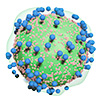
A single microrobot cleans pollutants from wastewater then repurposes them to kill cancer cells, executing both tasks in sequence without retrieval or reprocessing between jobs.
(Nanowerk Spotlight) Most micro- and nanorobots can already do more than one thing. Some combine medical imaging with targeted heating to destroy diseased tissue. Others break down chemical contaminants while killing bacteria. But these multifunctional designs typically perform their tasks at the same time or in parallel. Once a given job is finished, the robot’s surface may be clogged, its chemistry altered, or its payload consumed, leaving it unable to take on a different assignment. The machine may still be intact, but it has nothing left to give.
A more ambitious goal is to make a microrobot complete one task in one field, then seamlessly move on to a completely different task in another field, with the first job actually setting up the second. Biology does this routinely. In living cells, chains of enzymes pass molecules down a production line: each enzyme transforms the product of the previous step into the starting material for the next, sustaining an unbroken sequence from raw input to final output.
A team of researchers has now applied that relay logic to a synthetic microrobot, reporting their results in Advanced Functional Materials (“Functional‐Coupling Biohybrid Microrobots for Autonomous Cross‐Domain Task Flow”). They call the strategy “functional coupling,” meaning that the robot’s condition after completing one task is precisely what it needs to begin the next, with no retrieval, cleaning, or chemical reset in between. Using this approach, they linked two traditionally separate domains: environmental remediation and cancer therapy.
Schematic illustration of biohybrid microrobots for executing cross-domain task flow via functional-coupling. (Image: Reproduced with permission from Wiley-VCH) (click on image to enlarge)
The robot starts with biology. Its core is a single cell of Chlorella, a common freshwater alga roughly 3–5 µm across. These cells are spherical, uniform, abundant, and cheap to grow, making them a practical scaffold for mass production. The idea of turning magnetic nanoparticle-coated microalgae into steerable robots has gained traction as a low-cost route to biohybrid systems. Here, the researchers fixed the cells with glutaraldehyde to lock their shape, then coated them with iron oxide (Fe₃O₄) nanoparticles through a chemical precipitation process. This magnetic shell turns the alga into a steerable vehicle.
A final layer of graphene oxide (GO) nanosheets completes the design. GO is a carbon-based material rich in oxygen-containing chemical groups that attract and bind positively charged molecules. It also absorbs near-infrared light and converts it to heat. Together, the three components, Chlorella body, magnetic shell, and GO skin, form the finished microrobot, designated Ch/Fe₃O₄/GO.
Confirming that each layer deposited correctly required tracking changes in composition at every stage. After the iron oxide step, cross-sectional imaging showed iron and oxygen spread uniformly across the algal surface, indicating a dense nanoparticle shell. After GO loading, a thin film covered the entire microsphere. Diffraction and spectroscopic data confirmed the chemical signatures of both GO and Fe₃O₄ in the final product, and magnetic measurements verified that the robot was strong enough for reliable steering.
Propulsion relies on a rotating magnetic field. Inside a triaxial Helmholtz coil system, the spherical robot tilts slightly off its vertical axis, spins, and rolls forward through friction with the surface beneath it. At the optimal rotation frequency of 8 Hz, individual robots moved efficiently through water and could be magnetically herded into swarms for collective deployment through channels.
The first task in the workflow is wastewater cleanup. Methylene blue (MB), a positively charged organic dye widespread in industrial effluent, served as the target pollutant. GO’s negatively charged surface groups grab MB through electrostatic attraction and a form of molecular stacking called π–π conjugation.
Crucially, moving robots adsorbed far more dye than stationary ones. Robots sitting still removed roughly half the MB from solution in 10 minutes. At the optimal frequency, that figure jumped to 81 %, because the self-stirring effect of the robot’s motion brought it into contact with more dye molecules.
To show that cleanup works on the move, the team loaded MB solution into a Y-shaped 3D-printed microchannel and placed a robot swarm at one end. Under magnetic guidance, the swarm migrated along the channel. The solution faded progressively behind it, confirming that the robots kept adsorbing dye throughout their journey.
At this point the robot is coated in MB, and here the functional-coupling logic kicks in. MB is not just a pollutant. It is also a photosensitizer, a molecule that generates cell-killing reactive oxygen when exposed to the right wavelength of light. The robot does not need to be retrieved and reloaded with a therapeutic agent. The pollutant it just cleaned up is the therapeutic agent.
Delivery to cancer cells depends on a built-in pH trigger. At the neutral pH of healthy tissue, GO’s ionized surface groups grip MB tightly. But tumors maintain a mildly acidic microenvironment. As acidity rises, those surface groups pick up protons and lose their negative charge, weakening the electrostatic hold and releasing the dye.
In experiments, MB release increased roughly sevenfold when the pH dropped from neutral to acidic conditions mimicking a tumor. In practice, this means MB stays locked on the robot during transit and comes off preferentially near cancer cells.
Once released, MB generates singlet oxygen, a highly reactive form of oxygen toxic to cells, when illuminated with a 664 nm laser. The GO coating adds a second killing mechanism: under 808 nm near-infrared laser irradiation, it converts light into heat, rapidly raising the local temperature. Previous work has shown that algae-based microrobots can deliver cancer drugs with precision, but this system goes further by generating its therapeutic payload in situ, during the environmental cleanup step, rather than loading it beforehand.
The two effects proved far more potent together than apart. When MCF-7 breast cancer cells were treated with MB-loaded robots and exposed to both lasers sequentially, cell viability fell to just 24.4 %. Either laser on its own caused only modest or partial cell death. Live-dead staining confirmed the synergy: widespread markers of dead cells appeared only under dual-laser treatment. Importantly, normal cells incubated with the same robots showed negligible toxicity, suggesting the system discriminates between cancerous and healthy tissue.
The team validated the entire two-task sequence in a single continuous experiment using a linear 3D-printed microchannel with three wells. Robots started in the left well, were magnetically swarmed into a central well containing MB solution, adsorbed the dye, and then were guided into a right well holding cancer cells. There, laser irradiation raised the local temperature to 60 °C. At no point was the robot retrieved, washed, or chemically reactivated between tasks.
The individual capabilities demonstrated here, magnetic steering, dye adsorption, photothermal heating, photodynamic killing, have each appeared in other microrobot systems. What sets this work apart is the unbroken chain connecting them. By engineering the output of the environmental task (a surface loaded with photosensitizer) to serve directly as the input of the biomedical task, the robot turns a waste product into a weapon against cancer cells.
Whether this specific pairing reaches clinical or industrial use will depend on in vivo testing, scalability, and regulatory hurdles the study does not address. But the functional-coupling principle itself is transferable, offering a design template for future micro- and nanorobots that chain multiple tasks into continuous, multi-stage operations.
For authors and communications departmentsclick to open
Lay summary
Prefilled posts
Nanowerk Newsletter
Get our Nanotechnology Spotlight updates to your inbox!
Thank you!
You have successfully joined our subscriber list.
Become a Spotlight guest author! Join our large and growing group of guest contributors. Have you just published a scientific paper or have other exciting developments to share with the nanotechnology community? Here is how to publish on nanowerk.com.