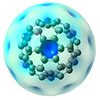
Fullerene’s perfect symmetry turns a long-standing weakness of molecular electronics into a programmable three-state switch.
(Nanowerk Spotlight) Shrink an electrical switch down to the size of a single molecule and the current flowing through it becomes hostage to geometry. At that scale, the signal depends not just on what the molecule is, but on exactly how it sits between the electrodes. Tilt it a few degrees, bond it through a different atom, and the output changes unpredictably.
This orientation sensitivity is why most molecular switches operate in only two states. Achieving a third or fourth stable conductance level has been possible in rare experiments, but the extra states tend to be noisy and hard to reproduce. Each added level creates another opportunity for the geometry to interfere.
C₆₀, the hollow carbon cage discovered in 1985 and shaped almost exactly like a soccer ball, is immune to this problem. Its 60 carbon atoms form a closed sphere with electrons distributed uniformly across the surface, so the molecule conducts electricity the same way regardless of which direction it faces. That property has already proven useful: researchers have previously demonstrated that a single fullerene molecule can act as a fast electronic switch capable of redirecting electrons on ultrafast timescales.
The research team stacked one, two, and three C₆₀ molecules between gold electrodes and found that each arrangement produces a distinct and fully reversible conductance level, with the three states spanning nearly four orders of magnitude. Mechanical adjustment of the electrode gap selects which state the junction occupies.
Because every fullerene in the stack conducts identically regardless of its orientation, the conductance depends only on how many molecules are present, not on how they are arranged. The result is a molecular switch that is structurally flexible yet electronically deterministic.
Concept of mechanically controlled multistate conductance in fullerene junctions. (a) Comparison of representative π–conjugated molecular systems, highlighting the transition from planar conjugated molecules with anisotropic electronic distributions to the spherical geometry and isotropic π–electron delocalization of fullerene (C₆₀). (b) Schematic illustration of a C₆₀ junction under mechanical control, where pushing and pulling of the STM tip reversibly modulate the number of stacked C₆₀ molecules bridging the junction, giving rise to three discrete conductance states dominated by a single molecule, a dimer, and a trimer, respectively. (c) Corresponding schematic conductance–state diagram illustrating the discrete and reversible nature of the multistate switching. (Image: Reproduced with permission from Wiley-VCH)
To build and test these junctions, the team used a technique in which a sharp gold tip is repeatedly driven into a gold substrate and then pulled away in a solution of C₆₀ dissolved in 1,2,4-trichlorobenzene at a concentration of approximately 0.1 mM. As the tip retracts, fullerene molecules slip into the widening gap and bridge the electrodes. The conductance is recorded continuously during each withdrawal.
Thousands of these stretching cycles revealed a consistent pattern. Three step-like conductance plateaus appear in sequence as the junction elongates, and statistical analysis confirms three cleanly separated peaks. The average plateau lengths grow in discrete steps, measuring roughly 0.3 nm, 1.1 nm, and 1.5 nm, consistent with junctions containing one, two, and three stacked C₆₀ molecules. The increments are not simple multiples of the molecular diameter, which points to structural relaxation: as more fullerenes join the stack, axial compression and lateral offsets between neighbors reduce the effective elongation.
The most important test was whether these conductance states arise from controlled stacking rather than random rearrangements of the electrode contacts. The team settled this through independent measurements at 4.8 K under ultra-high vacuum. They functionalized a gold tip with a single C₆₀ molecule and measured conductance on three surfaces: bare gold, gold covered with one layer of C₆₀, and gold covered with two layers.
These configurations force junctions of exactly one, two, and three fullerenes. The conductance values matched quantitatively with those from the room-temperature experiments, confirming that the discrete states correspond to specific stacking numbers.
A separate line of evidence addressed how electrons actually travel through a stack of fullerenes that are not covalently bonded to one another. Noise measurements tracking tiny current fluctuations showed that single-molecule junctions conduct through coupling between the gold and the fullerene’s electron cloud. For the two- and three-molecule stacks, the noise characteristics shifted, indicating that electrons cross the gaps between adjacent C₆₀ units through noncovalent, through-space interactions.
The fullerenes are held together by van der Waals attraction, the same short-range force that lets a gecko cling to glass, yet these weak bonds support well-defined conduction channels.
The computational analysis told a consistent story. Calculated electron transmission through junctions with different numbers of C₆₀ molecules drops exponentially with each additional unit, consistent with coherent quantum tunneling, a process in which electrons pass through an energy barrier rather than climbing over it.
When the calculations were repeated for trimers with different orientations and stacking geometries, the results barely changed. Extra C₆₀ molecules placed near but not within the main conduction pathway had negligible effect. What determines the conductance is how many fullerenes sit along the electrode axis, not their precise arrangement.
To demonstrate programmability, the team designed mechanical push-pull sequences with predefined displacement waveforms targeting specific state patterns. The junction reproduced these sequences faithfully, switching among all three conductance levels with high contrast and no measurable drift across repeated cycles.
Three well-separated and mechanically addressable conductance levels in a single molecular junction open a path toward multilevel information encoding at the smallest possible scale. Each state could serve as a distinct electronic weight, a basic requirement for hardware that mimics the graded signaling of biological synapses.
Translating this physics into integrated devices will require solving problems of electrode fabrication, parallel addressing, and long-term stability under ambient conditions.
But the underlying principle is now clear: the spherical symmetry of C₆₀ decouples electronic transport from structural configuration, allowing flexible molecular assemblies to produce stable, repeatable, and deterministic multistate switching.
For authors and communications departmentsclick to open
Lay summary
Prefilled posts
ORCID information
Yaping Zang (Institute of Chemistry, Chinese Academy of Sciences)
, 0000-0002-1923-3758 corresponding author
Nanowerk Newsletter
Get our Nanotechnology Spotlight updates to your inbox!
Thank you!
You have successfully joined our subscriber list.
Become a Spotlight guest author! Join our large and growing group of guest contributors. Have you just published a scientific paper or have other exciting developments to share with the nanotechnology community? Here is how to publish on nanowerk.com.