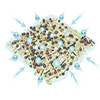
A hygroscopic paper produced on industrial papermaking equipment harvests drinking water from air continuously using sunlight, bridging the gap between laboratory sorbent materials and field deployment.
(Nanowerk Spotlight) Pulling drinking water directly from humid air, a process known as atmospheric water harvesting, works well in the laboratory. Researchers have developed dozens of materials engineering strategies for atmospheric water harvesting, including metal-organic frameworks, hydrogels, and salt-based composites, some absorbing several times their own weight in water. But few of these materials have made it from the laboratory to a working field device. The synthesis routes are complex, the raw materials expensive, and production volumes stuck at grams or small sheets.
The devices that house these materials face a separate bottleneck. Most operate in batch mode: the sorbent absorbs moisture in an open chamber, the chamber seals, a heat source drives the water out, the vapor condenses, and the cycle restarts. Each pause between rounds wastes time, and for materials with fast sorption kinetics that could cycle far more frequently, batch operation leaves much of their capacity unused. Studies have shown that continuous and efficient collection of clean water from air can outperform intermittent systems by 100% to 200% in total water yield.
With projections pointing to a 40% gap between global water demand and supply by 2030, and nearly six billion people expected to face water scarcity by 2050, closing the distance between laboratory performance and field-deployable hardware is urgent. A study published in Advanced Energy Materials (“Scalable Atmospheric Water Harvesting Paper Enable Rapid and Continuous Water Collection”) found a manufacturing shortcut in an unlikely place: the papermaking industry.
Paper water harvester device operating in continuous mode. (a) Schematic of a crawler-type device with P/LiCl paper that continuously collect water. (b) Schematic microstructure of P/LiCl paper. (c) Adsorption and (d) desorption process of P/LiCl paper during device operation. (Image: Reproduced with permission from Wiley-VCH Verlag) (click on image to enlarge)
The research team built a hygroscopic sorbent on a conventional papermaking line, producing rolls of cellulose-based paper loaded with chloride-doped polypyrrole (PPy-Cl) and lithium chloride (LiCl). They then paired it with a solar-driven crawler device that rotates continuously, absorbing moisture from ambient air on one side while simultaneously releasing and condensing water on the other, with no downtime between cycles.
The key advantage of this approach is that every fabrication step uses established industrial equipment. Cellulose pulp passes through standard forming, pressing, and drying stages to produce a thin sheet. That sheet enters a pyrrole monomer bath, followed by an oxidant solution that polymerizes PPy-Cl directly onto and within the fiber matrix. A final soak in a 3 wt% LiCl solution loads the hygroscopic salt, after which the paper is dried and wound into rolls. The result is a flexible, dark-colored sheet roughly 100 µm thick with a highly porous internal structure.
Each component in the paper serves a distinct function. LiCl, distributed across fiber surfaces and within pores, captures water molecules through strong ion-dipole interactions that weaken progressively as the material takes on more moisture. Additional water fills the cellulose fiber network through capillary action, effectively turning the paper into a thin sponge.
PPy-Cl serves a dual purpose. Its polar functional groups contribute mild hygroscopicity, while its broad-spectrum light absorption converts sunlight into heat, a principle also explored in other solar-powered atmospheric water harvesting systems. Under one standard sun of illumination, the paper stabilizes near 70 °C within two minutes.
During desorption, weakly bound water in the PPy-Cl matrix releases first at lower temperatures, which disrupts the hydration shells around lithium ions and reduces the energy barrier for liberating the more tightly held moisture. This gradient desorption pathway keeps the overall energy demand low.
The kinetic performance reflects this cooperative design. At 30% relative humidity (RH), the paper reaches 80% of its saturated water uptake in just 14 minutes and sheds most of its captured water within 15 to 20 minutes under solar-driven heating, a sorption-desorption speed that exceeded all comparable sorbents surveyed in the study. Twenty consecutive cycles under simulated sunlight showed no measurable degradation.
To exploit these fast kinetics, the team designed a continuous-operation crawler device. A belt of polypropylene nonwoven fabric, loaded with the P/LiCl paper, rotates around four rollers driven by a small motor. As the belt passes through the lower, open section, the paper absorbs atmospheric moisture, aided by a fan that accelerates airflow. When it rotates upward into an enclosed transparent acrylic chamber, sunlight heats the paper and drives desorption. Released vapor condenses on cooler internal surfaces, producing a temperature differential of about 40 °C that drives condensation. Collected water drains into an external bottle.
The team developed a mathematical model to identify the optimal rotation speed for each humidity condition, settling on 20-minute cycles. The entire device weighs 3.26 kg, small enough for one person to carry and deploy. Its motor and fan consume negligible electricity, while the energy-intensive desorption step runs entirely on sunlight.
Field testing ran for 15 non-rainy days in Tianjin, China, with relative humidity ranging from 15% to 65.8%. The device completed more than 500 adsorption-desorption cycles, reaching a normalized water output of 13.3 grams of water per square meter of device area per hour.
The collected water met World Health Organization drinking water standards, with lithium ion concentrations far below those found in typical natural freshwater. The calculated cost for the complete device, including the sorbent paper, stands at $49.71, which the researchers project could decrease further with industrial-grade raw materials and injection-molded components.
By building its sorbent chemistry on one of the oldest and most scalable manufacturing platforms available and coupling it with a mechanically simple, continuously operating device, the study offers a practical blueprint for moving atmospheric water harvesting out of the laboratory. The researchers identify long-term field validation in arid deserts and high-salinity coastal environments as the next critical step, alongside integrating sensors that dynamically adjust crawler speed to match shifting temperature and humidity conditions.
Chuanling Si (Tianjin University of Science and Technology)
, 0000-0003-1630-7800 corresponding author
Nanowerk Newsletter
Get our Nanotechnology Spotlight updates to your inbox!
Thank you!
You have successfully joined our subscriber list.
Become a Spotlight guest author! Join our large and growing group of guest contributors. Have you just published a scientific paper or have other exciting developments to share with the nanotechnology community? Here is how to publish on nanowerk.com.