| Mar 10, 2026 |
The GPCRact AI model goes beyond AlphaFold3 by predicting whether drugs functionally activate G-protein-coupled receptors through allosteric signaling.
|
|
(Nanowerk News) A research team has developed an artificial intelligence system that pushes past a key limitation of AlphaFold3. Where Google DeepMind’s tool predicts whether drugs bind to proteins, the new model, called GPCRact, goes a step further by forecasting whether that binding actually triggers biological activity inside a cell. Targeting G-protein-coupled receptors, one of the most important classes of drug targets in modern pharmacology, GPCRact incorporates the internal signaling dynamics that determine whether a protein switches on or off after a molecule attaches to it.
|
Key Findings
- The GPCRact model predicts not only drug-receptor binding but also whether that binding leads to functional protein activation through allosteric signal propagation.
- It outperformed existing models on structurally complex proteins that had previously been difficult to analyze.
- The system identifies the internal signaling pathways behind its predictions, offering interpretability that conventional black-box AI approaches lack.
|
|
Proteins in the human body operate like molecular switches. When a drug binds to a protein, localized structural changes at the binding site can propagate through the molecule, ultimately turning its function on or off. Tools such as AlphaFold3, developed by Google DeepMind, have made major progress in predicting whether drugs bind to proteins and resolving the three-dimensional structure of binding sites. Yet they remain unable to model what happens next: how signals travel through the protein interior, how the overall conformation shifts, and whether the protein’s function is ultimately activated or suppressed.
|
 |
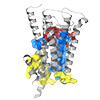
| Schematic diagram of drug activity prediction and mechanism interpretation using the GPCRact artificial intelligence model. (Image: KAIST)
|
|
A team led by Professor Gwan-Su Yi of the Department of Bio and Brain Engineering at KAIST set out to close this gap. The resulting model, GPCRact, specifically targets G-protein-coupled receptors. GPCRs serve as signal receivers on the surface of cells. When hormones, neurotransmitters, or drugs arrive from outside the cell, GPCRs act as gateways that capture these signals and relay them to the cell interior. Approximately 800 types of GPCRs exist in the human body, and an estimated 30 to 40 percent of currently marketed drugs act on them. These receptors regulate a wide range of physiological processes, including heart rate, blood pressure, pain perception, immune function, and emotional regulation.
|
|
The central challenge is that a drug binding to a GPCR does not automatically produce the intended therapeutic effect. Structural rearrangements within the protein and the subsequent transmission of signals, a process known as allosteric signal propagation, determine whether the drug genuinely works. To capture this complexity, the research team designed GPCRact to learn drug action in two stages. The first stage models drug-target binding. The second stage models intracellular signal propagation within the protein itself. The three-dimensional protein structure is represented as an atom-level graph, and an attention mechanism enables the model to identify important signaling pathways within that graph.
|
|
Through this architecture, the AI analyzes both the initial binding event and the downstream internal signaling routes to predict whether a given receptor becomes functionally activated. In testing, GPCRact substantially improved prediction accuracy for drug activity in structurally complex proteins where prior models had struggled. Crucially, the model does not simply output a binary active or inactive classification. It also highlights the key internal signaling pathways that underpin each prediction, directly addressing the interpretability limitations that have plagued many deep learning approaches in drug discovery.
|
|
This transparency has practical consequences. Researchers can examine and verify the reasoning behind each prediction, which improves both the reliability and efficiency of the drug development pipeline. Looking ahead, the team envisions GPCRact evolving into a precision drug discovery platform capable of predicting functional activation across a range of diseases that involve GPCR targets.
|
|
“Allosteric structural change refers to a phenomenon in which a drug binds to one part of a protein and its influence propagates internally, altering the function of other regions,” Professor Gwan-Su Yi explained. “The key contribution of this research is incorporating this operational principle into deep learning.” He added, “We plan to expand the model to various proteins and ultimately develop technologies capable of predicting cellular and whole-body responses.”
|
|
The paper was published in Briefings in Bioinformatics (“GPCRact: a hierarchical framework for predicting ligand-induced GPCR activity via allosteric communication modeling”).
|