| Feb 09, 2026 |
A DNA-based nanodevice applies controlled force to individual proteins, enabling researchers to observe molecular changes and discover new protein interactions for the first time.
(Nanowerk News) Physical forces from gravity, muscle contraction, and more have strong impacts on how the cells in our bodies behave. For instance, weight-bearing exercise helps stave off osteoporosis because cells in our bones sense that force and build more bone to support it. Cells of our arteries sense the force from high blood pressure, which triggers biological responses to bring blood pressure down.
|
|
Measuring and observing how forces affect cells and proteins, however, has been challenging. But a new tool developed by Yale School of Medicine (YSM) researchers and described in Nature Nanotechnology (“DNA nanodevice for analysis of force-activated protein extension and interactions”) provides a way to see exactly what force is doing to the molecules that bear those forces.
|
|
Cells sense force largely through proteins, which change their shape when force is applied. The researchers built a nanodevice that can apply controlled force to individual proteins. Doing so allows researchers to test how force changes protein interactions.
|
|
“We haven’t been able to establish a deep molecular understanding of how force acts on proteins, because there has been no way to do structural biology on proteins under tension,” says co-senior author Martin Schwartz, PhD, Robert W. Berliner Professor of Medicine (Cardiology) and professor of cell biology at YSM. “But the nanodevice we’ve invented fills that need.”
|
 |
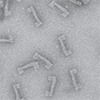
| Nanodevice Design. Top: A U-shaped frame (blue) with DNA “handles” (black). Middle: The handles attach to tethers (green) that are attached to a protein of interest (orange). Bottom: When the DNA is triggered to fold (handle on the left), it pulls on the protein, exerting force. (Image: Yale University)
|
Nanodevice applies force to proteins
|
|
The bulk of the nanodevice is a U-shaped frame that acts as a clamp. Attached to each of the “arms” of the frame are small lengths of DNA referred to as “handles.”
|
|
“We can attach a tether to each end of the protein and that tether then attaches to the DNA handle,” says Chenxiang Lin, PhD, professor of cell biology at YSM and co-senior author of the study. “This suspends the protein of interest in the cavity of the frame.”
|
|
“The magic happens,” he says, when we trigger one or both of the DNA handles to fold in on itself. That pulls on the protein, which should make it change shape.
|
|
To test the nanodevice, the researchers used it to evaluate a well-studied protein called talin that’s involved in connecting membrane proteins to a cell’s actin cytoskeleton (the cell’s “muscles”).
|
|
The researchers loaded a piece of talin that can sense mechanical tension into the nanodevice and activated the device to tug on the protein. Talin is known to bind to another protein called vinculin when force is applied, and the researchers observed that to be the case when their nanodevice was activated, confirming the device applied biologically relevant force.
|
|
The researchers then used the device to do something they haven’t been able to do in the past.
|
|
“We took talin and essentially used it to go fishing in a tub of proteins,” says Schwartz. “We went fishing with and without applied force to see if any other proteins might bind to talin.”
|
|
It was a successful fishing trip, as the researchers found another protein called filamin bound to talin when force was applied, the first time this has ever been observed.
|
|
While the researchers used a specific protein for the study, the nanodevice frame can be adjusted to fit pretty much any linear protein. And the team is working on ways to use this same approach for non-linear proteins, which are generally spherical and more compact compared with their simpler linear counterparts.
|
|
“You can imagine a square frame, rather than the U shape where multiple arms stick out and grab the protein from multiple points,” says Lin.
|
|
For Schwartz, the next step is to use the nanodevice to solve protein structures with and without applied force. That, he says, could help identify drugs that change how the proteins respond to force.
|
|
“If you can alter the way cells sense forces, you can manipulate their activity,” he says. “This was a goal I dreamed up years ago, and now we’re able to do it.”
|