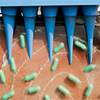
A food-safe gelatin microneedle sensor pierces sealed packaging and changes color as food spoils, offering consumers a real-time alternative to static expiry dates.
(Nanowerk Spotlight) Open a package of fish from the refrigerator three days after buying it and you face a familiar dilemma. It looks fine. It smells acceptable, maybe. The date on the label says “best before” tomorrow, or was it “use by” yesterday? The language varies by brand and jurisdiction, and none of it describes what is actually happening inside the package right now. So you guess.
Millions of people make this same guess every day, and they overwhelmingly guess wrong in the cautious direction: into the trash goes food that was still perfectly safe to eat. An estimated one-third of all edible food produced globally each year is discarded, and research suggests that 20–30% of consumer-level food waste involves products thrown away because people relied on printed dates that were never designed to reflect real-time product condition. Expiry labels are stamped at the factory based on conservative shelf-life models and cannot account for what happens to a package between store and home.
From a chemistry standpoint, spoilage is not a mystery. When protein-rich foods like fish deteriorate, bacteria break down amino acids into nitrogenous compounds such as putrescine, cadaverine, and trimethylamine, which drive a measurable rise in pH (the standard scale of acidity and alkalinity). This shift is predictable and well correlated with microbial overgrowth. Translating it into something a consumer could use has proved far harder.
The most promising avenue has involved anthocyanins, pigments naturally found in red cabbage and other plants, which change color as pH changes. Embedded in thin polymer films, these molecules can shift from purple to blue when food crosses a spoilage threshold. But anthocyanin films must be porous enough to interact with food moisture, which makes them unable to protect food from the environment and useless as standalone packaging. Layering them onto existing packaging raises costs the food industry has refused to absorb.
More recent designs used microneedle arrays, tiny projections that could physically sample food through its wrapping, but these relied on synthetic scaffolds, ultraviolet-cured materials, or external instruments, all of which undermined the simplicity and food safety that consumer adoption demands.
A study published in Advanced Science (“Food‐Activated Microneedle Sensor for Real‐Time, Colorimetric Spoilage Monitoring of Pre‐Packaged Food”) now presents a sensor that avoids these trade-offs. The device consists of two food-grade ingredients: gelatin and red cabbage anthocyanin. In its dry state, the sensor forms rigid microneedles strong enough to pierce sealed food packaging. Once those needles contact the moist surface of fish, they soften into a hydrogel, a water-swollen gel, that activates the embedded pigment. As the fish spoils and its pH rises, the sensor transitions from purple to blue in a progression visible to the naked eye.
Overview of gelatin-anthocyanin fish spoilage sensor. a) Schematic illustration of the developed sensor applied to sealed fish for real-time spoilage monitoring. b) Treatment-induced dehydration for mechanical integrity and ambient stability, followed by test fluid-induced rehydration for sensing. c) Food-mediated hydration of the sensing microneedles, which subsequently exhibit pH-induced color change from purple to blue as the food product spoils. d) Proof-of-concept application showing colorimetric shift from purple to blue across fish product lifespan. Scale bars depict 20 mm (left) and 10 mm (middle, right). (Image: Reproduced from DOI:10.1002/advs.202512602, CC BY) (click on image to enlarge)
The innovation centers on how the gelatin is processed. The researchers fabricated microneedles through three steps: gelation, freezing at −20 °C overnight, and dehydration at 30 °C for 24 hours. Freezing proved critical. As water within the gelatin matrix forms ice crystals, those crystals compress surrounding polymer chains, creating physical crosslinks (bonds between molecular strands) that persist after the ice melts.
The cavities left behind increase the material’s capacity to absorb liquid later. And water molecules trapped inside ice grain cores cannot bond stably with the gelatin network, making them easy to drive off during dehydration, which improves drying efficiency. The combined result is a material that is hard and shelf-stable at room temperature but reverts to a soft, sensing-capable hydrogel the moment it contacts food moisture.
After testing gelatin concentrations of 5%, 10%, 15%, and 20%, the team selected a 15% weight-per-volume formulation. With 24-hour dehydration, the microneedles showed a height reduction of roughly 12.8% under 100 gram-force and about 55.1% at 600 gram-force, numbers indicating strong mechanical integrity. Against polyethylene food packaging films of 14, 38, and 76 µm thickness, the needles achieved penetration rates above 93% on the thinnest film, with 100% reusability across ten successive trials. Performance held up at varied insertion angles, with alternative packaging materials, and against other food products.
Incorporating anthocyanin did not meaningfully weaken the microneedles. The team evaluated concentrations of 0.1%, 0.5%, and 0.9%, and the 0.5% formulation delivered the strongest balance between color response and practical performance. It produced an 8.8% mean color shift across the pH 6.0 to 8.0 range, the window most relevant to fish spoilage, and its absorbance changes tracked fish pH over six days with r-values above 0.95, a statistical measure of how tightly two variables move together.
Both mechanical strength and pH responsiveness remained stable after 21 days of ambient storage and after seven days at temperatures from −20 °C to 37 °C.
In proof-of-concept trials with haddock, the 0.5% sensors penetrated sealed polyethylene packaging and reached the underlying fish. Over four refrigerated days, the patches tracked spoilage with clear visual fidelity. On days one and two, while fish pH remained below the 7.0 spoilage threshold, the sensors held a distinct purple hue. By day three, when pH crossed that line, they shifted to blue, and the change intensified on day four. Smartphone-captured red-channel color intensity dropped from about 99.6 arbitrary units on day one to 57.1 by day four.
The team also validated a rapid-test mode for opened products. When pressed directly into spoiled fish, the sensors completed a full purple-to-blue transition within 45 minutes, with statistically significant shifts appearing at 15 and 30 minutes. Flat gelatin patches without microneedle structures produced no detectable response in the same window, confirming that the increased surface area of the needle geometry accelerates sensing.
Testing on cod and tilapia yielded visible color shifts within the same timeframe, supporting generalizability beyond a single species. The 0.9% anthocyanin formulation, which performed well in laboratory pH tests, failed during food trials because the limited moisture in fish tissue could not activate the denser pigment load.
To remove the subjectivity of reading color by eye, the team trained a convolutional neural network, a type of machine-learning model specialized for image recognition, to classify smartphone photos of used patches as either “Fresh” or “Spoiled.” Using transfer learning from a pretrained model and a training dataset of 30 images, the network achieved 100% accuracy on a separate blind test of 25 images, with zero false positives or negatives.
The authors suggest that subtle color shifts occurring before a full transition to blue could, with additional model training, support an intermediate “spoiling” classification. In the sealed-package scenario, this could alert consumers that a product is approaching the spoilage threshold. In rapid testing, it could shorten detection time. Every component of the sensor is food-derived, biodegradable, and inexpensive. Fabrication requires no specialized chemistry, no ultraviolet curing, and no electronic hardware.
If validated at production scale, the technology would give consumers something printed dates never could: a direct, real-time readout of what is actually happening to the food inside a sealed package.
For authors and communications departmentsclick to open
Lay summary
Prefilled posts
Nanowerk Newsletter
Get our Nanotechnology Spotlight updates to your inbox!
Thank you!
You have successfully joined our subscriber list.
Become a Spotlight guest author! Join our large and growing group of guest contributors. Have you just published a scientific paper or have other exciting developments to share with the nanotechnology community? Here is how to publish on nanowerk.com.