| Feb 05, 2026 |
Scientists a direct microscopic connection between a correlated normal state and the resulting superconductivity in so-called moire materials.
(Nanowerk News) Moiré materials consist of atomically thin crystals stacked with a slight twist relative to each other. These tiny twists fundamentally alter the behavior of the electrons, severely restricting their mobility while allowing their mutual interactions to dominate. This leads to the formation of novel quantum states, such as correlated insulators, magnetism and unconventional superconductivity.
|
|
Until now, however, the exact process by which superconductivity develops from such strongly correlated initial states was unclear. Understanding this process is crucial for advancing our knowledge of unconventional superconductors, including high-temperature superconductors.
|
|
In the recently published study (Nature, “Resolving intervalley gaps and many-body resonances in moiré superconductors”), the researchers combined high-resolution scanning tunnelling microscopy and spectroscopy with comprehensive theoretical modelling to investigate twisted graphene systems. These systems are particularly well suited to this study because they offer unprecedented experimental control over interactions, symmetry properties and filling.
|
 |
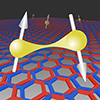
| The illustration shows the emergence of superconductivity from a prearranged correlated state with spontaneous symmetry breaking. (Image: Lorenzo Crippa)
|
|
Prof. Tim Wehling’s research group at the University of Hamburg’s Department of Physics made a significant contribution to the theoretical analysis. The theoretical analyses were carried out within the framework of the Cluster of Excellence “CUI: Advanced Imaging of Matter”, in close collaboration with international partners — particularly colleagues from Princeton, Würzburg and Frankfurt — and as part of the DFG research group QUAST.
|
|
The team asked itself two key questions: Firstly, what is the initial (normal) state from which superconductivity arises in twisted graphene moiré systems? Secondly, how are electronic correlations and symmetry breaking in the normal state related to subsequent superconductivity? Both questions are fundamental as the nature of the initial state can significantly impact the pairing mechanism of electrons, making it of central importance for strongly correlated superconductivity in general.
|
|
In their work, the researchers have identified the initial state from which superconductivity emerges in twisted graphene moiré systems. “We discovered that superconductivity does not arise from a simple metallic state, but from a pre-arranged correlated state involving spontaneous symmetry breaking. We were particularly fascinated by the discovery of a spiral-shaped order of the electronic ‘valley’ degree of freedom,” says Prof. Tim Wehling, from the Department of Physics at the University of Hamburg.
|
|
The study revealed several energy gaps, which depend on temperature and magnetic field. “We have thus found a direct microscopic connection between the normal correlated phase and the emerging superconductivity. This demonstrates the importance of the normal state for understanding unconventional superconductivity,” says Wehling.
|
|
The work provides a new understanding of how unconventional — and possibly also high-temperature — superconductivity arises. The concepts can be transferred to other material systems and, in the long term, could help develop new quantum materials and superconductors for future quantum technologies.
|