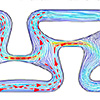
Aircraft wing-shaped structures inside tiny channels produce consistent drug delivery particles at any scale, from small laboratory tests to factory production, while substantially cutting costs.
(Nanowerk Spotlight) The success of COVID-19 mRNA vaccines marked a turning point for medicine. Billions of doses proved that lipid nanoparticles, tiny fat-based spheres measuring billionths of a meter across, could safely deliver genetic instructions into human cells on a global scale.
But this triumph obscured a stubborn problem. Developing the first FDA-approved lipid nanoparticle therapy, Onpattro, required screening more than 300 different ionizable lipids before researchers identified the optimal formulation. The process of creating and optimizing these microscopic delivery vehicles remains slow, expensive, and inconsistent.
Lipid nanoparticles protect fragile RNA molecules from degradation and guide them into target cells. Their performance depends on precise combinations of four components: ionizable lipids that respond to acidity, helper lipids that stabilize structure, cholesterol that modulates membrane flexibility, and polyethylene glycol lipids that extend circulation time in the bloodstream. Change one ratio and particle size shifts. Alter another and delivery efficiency plummets.
Traditional formulation methods rely on manual pipette mixing, which yields poor reproducibility. Automated systems improve throughput but often produce larger, less uniform particles. Microfluidic devices offer a promising alternative by forcing liquids through channels narrower than a human hair, enabling rapid and controlled mixing.
Yet most commercial microfluidic platforms operate with a single channel, limiting throughput. They risk cross-contamination between formulations and typically serve either small-scale screening or large-scale production. Rarely can one system do both.
A study published in Advanced Science (“Unique Aerofoil‐Structured Microfluidics for High Throughput Lipid Nanoparticle Formulation Screening and Scale‐up”) presents a platform designed to overcome these limitations. Researchers at University College Dublin engineered microchannels containing internal structures shaped like aircraft wing cross-sections. These aerofoil structures generate complex flow patterns that enhance mixing across flow rates spanning from 0.2 to 50 mL min⁻¹, a range covering more than two orders of magnitude.
The same underlying architecture works at both extremes. Scaled down, it handles screening experiments using as little as 0.1 mL of reagents. Scaled up, it supports continuous liter-scale production.
Overview and capabilities of the high-throughput lipid nanoparticles (LNP) platform. A) An overview of the LNP workflow (LNP screening to animal testing) using the high throughput platform; B) Positioning the high throughput platform in terms of throughput, cost, and cross-contamination with respect to existing technologies; C) Adaptability of aerofoil structures for different flow rates and volume. (Image: Reproduced from DOI:10.1002/advs.202511222, CC BY) (click on image to enlarge)
The platform consists of two complementary instruments. MiNANO-form uses a disposable plastic cartridge containing eight independent parallel channels, each with its own aerofoil mixer. Researchers can synthesize eight distinct formulations simultaneously without cross-contamination. The cartridge fits standard 96-well laboratory plates and works with 8-channel pipettes, slotting directly into existing workflows.
MiNANO-scale, the production instrument, employs a cartridge with aerofoil structures enlarged by a factor of 1.75. Twin peristaltic pumps sustain flow rates up to 50 mL min⁻¹ for continuous manufacturing.
The aerofoil geometry exploits pressure differences between its upper and lower surfaces, much as an airplane wing generates lift. At low flow rates, each structure splits incoming fluid at its leading edge and recombines the streams at its trailing edge. This repeated layering increases contact area between solutions and promotes mixing through diffusion.
As flow rates climb, pressure differentials intensify. The resulting folding-and-stretching effect brings high-concentration and low-concentration regions into close contact. At the highest flow rates, localized vortices form near trailing edges, amplifying the process further. This combination of mechanisms maintains consistent mixing performance across the entire operational range.
The researchers validated their designs through computational simulations and dye-tracing experiments. Predicted and observed results aligned closely, with relative errors below 18 % across all tested conditions.
The platform produced lipid nanoparticles ranging from 38 to 150 nm in diameter. Polydispersity index values, a measure of size uniformity where lower numbers indicate more consistent particles, remained below 0.2 throughout. These figures indicate high-quality, monodisperse formulations suitable for therapeutic development.
Using ionizable lipids found in approved COVID-19 vaccines and other therapeutics, including DDAB, SM-102, and ALC-0315, the team loaded particles with messenger RNA, plasmid DNA, and small interfering RNA. Encapsulation efficiency exceeded 85 % for mRNA and approached 90 % for plasmid DNA.
Experiments in three human cell lines, HEK293, A549, and CFBE, confirmed successful delivery. Particles induced the expected biological responses, including fluorescent protein expression and RNA uptake. Cell viability stayed above 90 %, indicating acceptable safety profiles.
The platform maintained consistent particle characteristics as production scaled up. Nanoparticles synthesized across the full flow-rate range showed average sizes of 38.7 nm ± 2.5 nm with polydispersity indices of 0.131 ± 0.045. This reproducibility addresses a persistent challenge in pharmaceutical development: ensuring that bench-scale formulations translate faithfully to manufacturing volumes.
Based on a 200-formulation screening campaign, the researchers estimate their system reduces reagent costs by roughly 58 % compared to a leading commercial platform. By enabling synthesis with as little as 100 μL per formulation, the approach conserves expensive genetic materials while still providing enough sample for thorough characterization.
The system can synthesize and characterize up to 25 distinct formulations per hour. This capacity to generate large, consistent datasets could support machine learning approaches to formulation optimization, though the researchers note that detailed integration of artificial intelligence remains a direction for future work.
RNA therapeutics are expanding beyond vaccines into gene therapy, cancer immunotherapy, and treatments for rare genetic disorders. Each new application requires its own optimized lipid nanoparticle formulation. A platform that moves seamlessly from discovery-stage screening to production-scale manufacturing, while maintaining particle quality throughout, addresses a genuine need in the field. The aerofoil-based system described here offers one promising path forward.
For authors and communications departmentsclick to open
Lay summary
Prefilled posts
Nanowerk Newsletter
Get our Nanotechnology Spotlight updates to your inbox!
Thank you!
You have successfully joined our subscriber list.
Become a Spotlight guest author! Join our large and growing group of guest contributors. Have you just published a scientific paper or have other exciting developments to share with the nanotechnology community? Here is how to publish on nanowerk.com.