| Feb 02, 2026 |
A hybrid graphene and molybdenum trioxide crystal allows real time electrical tuning of Bloch modes and light emission, overcoming the static limits of conventional polaritonic crystals.
(Nanowerk News) Polaritons are hybrid particles that form when light couples to vibrations or electrons in a material. Because they can squeeze light into spaces far smaller than its wavelength, they offer a route to photonic devices that are much smaller than today’s optical components. Researchers can push this control further by carving materials into periodic structures called polaritonic crystals.
|
|
These structures support Bloch modes, collective optical states that shape how light moves through the crystal. The problem is that once such a crystal is fabricated, its optical behavior is locked in place. That rigidity limits their use in devices that need to adapt or respond in real time.
|
|
Several materials point toward a solution, but each comes with tradeoffs. Graphene hosts plasmon polaritons that can be tuned electrically, yet they suffer from high optical losses. Other materials, such as alpha phase molybdenum trioxide, support phonon polaritons that confine light strongly and propagate with low loss. These phonon polaritons are also direction dependent, which is useful for steering light. However, they lack any built in mechanism for active tuning.
|
|
A new study published in Light: Science & Applications (“Dynamic tuning of Bloch modes in anisotropic phonon polaritonic crystals”) reports a way to combine the strengths of both systems. Researchers from Tongji University, Central South University, the City University of New York, and Pohang University of Science and Technology built a hybrid polaritonic crystal that couples a patterned layer of alpha phase molybdenum trioxide with a sheet of graphene. The molybdenum trioxide crystal was etched with a nanoscale array of holes, while the graphene layer provided electrical control.
|
|
In this stacked structure, phonon polaritons in the molybdenum trioxide interact with plasmon polaritons in graphene. The result is a new hybrid excitation known as a hybrid phonon plasmon polariton. These hybrid modes retain the low loss and directional properties of phonon polaritons while gaining the electrical tunability of graphene plasmons. In effect, the team turned a normally static polaritonic crystal into one that can be reconfigured on demand.
|
|
The key control knob is electrostatic gating. By applying a voltage, the researchers changed the charge density in graphene. This shift in the graphene’s electronic properties altered how it couples to light, which then reshaped the optical response of the entire crystal. Using scattering type scanning near field optical microscopy, they tracked these changes directly at the nanoscale. As the voltage varied, the Bloch modes changed their wavelength, intensity, and spatial pattern in real time.
|
|
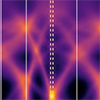
One of the most striking results was active control over the crystal’s band structure. The team showed that electrical gating could shift flat band regions so that they lined up with the frequency of the incoming laser. Flat bands concentrate optical states into a narrow energy range, which strongly boosts specific resonances. By moving these flat bands with a voltage, the researchers selectively amplified chosen Bloch modes.
|
|
They also demonstrated electrical switching of far field radiation. By shifting the flat bands into or out of the light cone, the boundary that determines whether modes can radiate into free space, they could turn light emission on or off without changing the physical structure of the crystal.
|
|
“This work establishes a reconfigurable platform for low loss Bloch modes with electrically switchable far field leakage in a graphene gated alpha phase molybdenum trioxide phonon polaritonic crystal,” the scientists stated.
|
|
“This platform paves the way for adaptive nanophotonic systems, including reconfigurable optical devices and on chip switches, advancing the field of dynamic nanophotonics,” they forecast.
|