| Jan 28, 2026 |
Observations with the Event Horizon Telescope enable researchers to localize the likely base of the central outflow in a massive galaxy.
|
|
(Nanowerk News) Some galaxies eject powerful streams of charged particles—jets—from their centers into space. The prominent jet of Messier 87 (M87) in the constellation Virgo is visible over distances of 3000 light-years and can be observed over the full electromagnetic spectrum. It is powered by the central engine, the supermassive black hole at the heart of the galaxy with a mass of around six billion times that of our Sun. The exact location around the black hole where the jets originate is still unknown.
|
|
Using observations from the Event Horizon Telescope (EHT) from 2021, an international research team led by Saurabh (Max Planck Institute for Radio Astronomy, MPIfR), Hendrik Müller (National Radio Astronomy Observatory, NRAO) and Sebastiano von Fellenberg (formerly at MPIfR, currently at the Canadian Institute for Theoretical Astrophysics, CITA) has found first hints of the jet base in M87. The results are published in the journal Astronomy & Astrophysics (“Probing jet base emission of M87* with the 2021 Event Horizon Telescope observations”).
|
 |
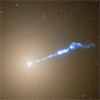
| A Hubble Space Telescope image of the giant elliptical galaxy M87 with its blowtorch-like jet. The visible part of this giant stream of particles spans around 3000 light-years. (Image: NASA, ESA, A. Lessing (Stanford University), E. Baltz (Stanford University), M. Shara (AMNH), J. DePasquale (STScI))
|
Observing different scales
|
|
M87*, the supermassive black hole at the center of the galaxy M87, is about 55 million light years (5 × 10²⁰ kilometers) away from Earth. In 2019, the first images of its shadow and the glowing ring of hot gas around it went around the world. In order to resolve these structures, radio telescopes around the world must be combined into a single virtual telescope such as the EHT. This technique is called Very Long Baseline Interferometry (VLBI).
|
|
The images produced in this way are sensitive to emission on different scales, depending on the distances between telescopes (baselines): With long baselines of several thousand kilometers, the smallest structures—such as the luminous ring—around M87* can be depicted. Short baselines of a few hundred meters, on the other hand, reveal emission emanating from much larger spatial scales in M87 (the extended jet), but are blind to details near the black hole.
|
|
Intermediate baselines of a few hundred to a few thousand kilometers are the important link. They can be used to establish a connection between the material around the black hole and the jet. Precisely these intermediate baselines enabled the research team to determine the probable position of the jet base.
|
|
“This study represents an early step toward connecting theoretical ideas about jet launching with direct observations. Identifying where the jet may originate and how it connects to the black hole’s shadow, adds a key piece to the puzzle and points toward a better understanding of how the central engine operates”, explains Saurabh.
|
 |
| At 230 GHz (bottom), data from the EHT reveal the fine structure of the ring surrounding the supermassive black hole M87*, though the jet remains too faint to image at these higher frequencies. The ring alone cannot account for the total emission measured on larger spatial scales. A compact feature provides the best explanation for this additional emission. It is spatially consistent with the southern component of the jet seen at 86 GHz (top right) in observations from 2018 with the Global mm-VLBI Array (GMVA). (Image: Bottom: Saurabh et al.: “Probing jet base emission of M87* with the 2021 Event Horizon Telescope observations”, Astronomy & Astrophysics 705 (2026), Figure 6. Upper Right: Lu, R.-S. et al.: “A ring-like accretion structure in M87 connecting its black hole and jet”. Nature 616 (2023), Figure 1)
|
The decisive difference
|
|
The researchers find hints to the base of the jet by comparing the measured radio intensity on different spatial scales: On short to intermediate baselines, the measured intensity is higher compared to that on long baselines. This indicates that what is observed with long baselines—the luminous ring of hot gas around the black hole—is not solely responsible for the detected radio emission. Instead, the current data show that part of the missing emission is captured on intermediate baselines. One possibility is the jet, which has not yet been observed at a radio frequency of 230 gigahertz (GHz) with the EHT.
|
|
EHT observations from 2017 and 2018 lacked the intermediate baselines to detect it. However, with the recently published data, Saurabh’s team was able to show with numerous model calculations that part of the missing emission can be best explained by an additional compact region. From our perspective, this region is about 0.09 light-years away from M87* and associated with the base of the jet. The position of the region appears to coincide with the southern arm of a radio jet discovered at a different frequency (86 GHz) in 2018.
|
|
“We have observed the inner part of the jet of M87 with global VLBI experiments for many years, with ever increasing resolution, and finally managed to resolve the black hole shadow in 2019. It is amazing to see that we are gradually moving towards combining these breakthrough observations across multiple frequencies and complete the picture of the jet launching region”, says Hendrik Müller.
|
What’s next?
|
|
The current study shows that these interesting structures around M87* become visible at radio frequencies of 230 GHz with intermediate baselines. However, further observations with the EHT will be necessary to further constrain the morphology of the jet. These observations will then make it possible to not only deduce structures such as the jet base, but to image them. This opens up new possibilities for probing the direct environment of supermassive black holes and for testing theories of black hole physics.
|
|
“Newly observed data—now being correlated and calibrated with support from MPIfR—will soon add back the Large Millimetre Telescope in Mexico. This will bring an even sharper view of the jet‑launching region within reach”, says Sebastiano von Fellenberg.
|