| Jan 14, 2026 |
Scientists detect the lowest mass dark object currently measured – an exotic concentration of dark matter?
|
|
(Nanowerk News) Dark matter is an enigmatic form of matter not expected to emit light, yet it is essential to understanding how the rich tapestry of stars and galaxies we see in the night sky evolved. As a fundamental building block of the universe, a key question for astronomers is whether dark matter is smooth or clumpy, as this could reveal what it is made of. Since dark matter cannot be observed directly, its properties can only be determined by observing the gravitational lensing effect, whereby the light from a more distant object is distorted and deflected by the gravity of the dark object.
|
|
“Hunting for dark objects that do not seem to emit any light is clearly challenging,” said Devon Powell at the Max Planck Institute for Astrophysics and lead author of the study (Nature Astronomy, “A possible challenge for cold and warm dark matter”). “Since we can’t see them directly, we instead use very distant galaxies as a backlight to look for their gravitational imprints.”
|
|
The team used a network of telescopes from around the world, including the Green Bank Telescope, the Very Long Baseline Array and the European Very Long Baseline Interferometric Network. The data from this international network were correlated at the Joint Institute for VLBI ERIC in the Netherlands, forming an Earth-sized super-telescope that could capture the subtle signals of gravitational lensing by the dark object.
|
 |
| A possible scenario for an object comprising a black hole with a mass approximately 300,000 times that of our sun and an extended dark disk with even more mass. This object can only be characterized by its combined gravitational lensing effect on the distant universe. (Image: Max Planck Institute for Astrophysics)
|
|
John McKean from the University of Groningen, the University of Pretoria, and the South African Radio Astronomy Observatory, who led the data collection and is the lead author of a companion paper, stated: “From the first high-resolution image, we immediately observed a narrowing in the gravitational arc, which is the tell-tale sign that we were onto something. Only another small clump of mass between us and the distant radio galaxy could cause this.”
|
An unknown dark and compact object
|
|
They found that the object has a mass that is a million times greater than that of our Sun and is located in a distant region of space, approximately 10 billion light years from Earth, when the universe was only 6.5 billion years old. Since light travels at a finite speed, every glimpse into the depths of space is also a glimpse into the past. This is the lowest mass object to be found using this technique, by a factor of about 100.
|
|
To achieve this level of sensitivity, the team had to create a high-fidelity image of the sky using radio telescopes located around the world. In terms of its overall size, structure and mass, the object could fall within the family of ultra-compact dwarf galaxies with some extended stellar halo of stars. These are rare systems that bridge the gap between massive star clusters and small galaxies. However, the measured internal structure of the object is highly unusual, does not emit any light itself, and suggests an alternative explanation, such as a highly compressed halo of dark matter inside.
|
Analysis using a Supercomputer
|
|
To analyze the massive dataset, the team had to develop new modelling algorithms that could only be run on supercomputers. “The data are so large and complex that we had to develop new numerical approaches to model them. This was not straightforward as it had never been done before,” said Simona Vegetti at the Max Planck Institute for Astrophysics. “We expect every galaxy, including our own Milky Way, to be filled with dark matter clumps, but finding them and convincing the community that they exist requires a great deal of number-crunching,” she continued.
|
 |
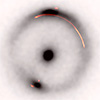
| Overlay of the infrared emission (black and white) with the radio emission (colour). The dark, low-mass object is located at the gap in the bright part of the arc on the right-hand side. (Image: Keck/EVN/GBT/VLBA)
|
|
The team applied a special technique called gravitational imaging, which allowed them to ‘see’ the invisible dark matter clump by mapping its gravitational lensing effect against the radio-luminous arc.
|
|
“Given the sensitivity of our data, we were expecting to find at least one dark object, so our discovery is consistent with the so-called ‘cold dark matter theory’ on which much of our understanding of how galaxies form is based,” said Powell. “Having found one, the question now is whether we can find more and whether their number will still agree with the models.” Initial attempts to explain the data pointed to a dark matter halo surrounding a young galaxy and ruled out a black hole weighing millions of solar masses or a large globular cluster as the cause.
|
A collapsed dark matter halo?
|
|
After Vegetti and her team thoroughly analyzed the precise data from the gravitational lens, they were able to constrain the origin of the signal even better and characterize the structure of the object with unprecedented detail.
|
|
“The central inner part is strikingly compact, consistent with either a black hole or a dense stellar nucleus that surprisingly makes up about a quarter of the total mass of the object. As we go out from the centre, however, the density of the object flattens into a broad, disk-like component. This is a structure that we really haven’t seen before, and so, it may be a new class of dark objects”, Vagetti says.
|
|
The structure is reminiscent of an ultra-compact dwarf galaxy with an extended stellar halo. However, the team has not yet detected any light from stars embedded in the object.
|
|
“Our standard view of how cosmic structure forms predicts that there should be many starless dark matter lumps with mass a million times that of the Sun. But it predicts a structure for them which is very different, in particular much less centrally concentrated, than what we have found here”, says Simon White.
|
|
Although the observed properties of the object deviate dramatically from the predictions of the standard model of cold dark matter, which underpins much of our understanding of the universe, there is a speculative alternative: the interaction of dark matter with itself. In such a scenario, the object could be a halo of dark matter whose center has collapsed and formed a black hole. However, additional numerical simulations are needed to test whether such a theory can reproduce the observed density profile of the object.
|
|
This is the third object of this type identified using the so-called gravitational imaging method. However, it is by far the smallest in terms of mass and the first to be characterized so precisely. All three discoveries have properties that are difficult to fit into the standard model of dark matter. The team is also investigating other parts of the sky to search for more low-mass dark objects using the same technique. If more of these mysterious objects are found in other parts of the universe and they turn out to be completely devoid of stars, some theories about dark matter could be ruled out.
|
Additional Information
|
|
Gravitational lensing: This is an astrophysical tool used by astronomers to measure the mass properties of structures in the Universe. It is a consequence of Einstein’s Theory of General Relativity, where mass in the Universe curves space. If the mass of the foreground lensing object (typically a galaxy or cluster of galaxies) is sufficiently dense, then the light from distant objects is distorted and multiple images are even observed. In the case of this system, called B1938+666, the foreground infrared-luminous galaxy (seen at the centre of the ring), results in a beautiful Einstein ring of the distant galaxy. However, the distant galaxy is also bright at radio wavelengths, showing the beautiful multiple images and gravitational arcs (seen in red).
|
|
Very Long Baseline Interferometry: The radio observations were taken using a combination of radio telescopes that are combined to form a so-called Very Long Baseline Interferometer. This observational method allows astronomers to improve the imaging sharpness of the data and reveal very small fluctuations in the brightness that otherwise could not be seen. For example, the resolving power of the data is a factor of 13 times better than the infrared imaging from the W. M. Keck Telescope adaptive optics system (also shown in the figures in black and white). The telescopes used in the observations were the Green Bank Telescope and the Very Long Baseline Array of the National Radio Astronomy Observatory in the United States, and the telescopes of the European Very Long Baseline Interferometric Network.
|
|
Gravitational imaging: This is a novel method that astronomers use to ‘see’ mass in the Universe even though it does not emit any light. This method uses the extended gravitational arcs to look for small aberrations that can only be caused by an additional, invisible component of mass. By combining this method and the exquisite high angular resolution imaging from the data, the team was able to detect the presence of the lowest mass dark object currently measured.
|