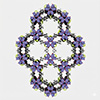
A titanium-based metal-organic framework achieves record electron storage density among MOFs and releases these accumulated charges to produce hydrogen gas without any additional light.
(Nanowerk Spotlight) A white powder sits in a sealed vial under ultraviolet light. Within minutes, it turns black. Remove the light, keep oxygen out, and the material stays black for over two days. Expose it to air, and it snaps back to white in under a second. This reversible transformation, driven by electrons accumulating inside a porous crystalline material, represents an unusual feat in photocatalysis research.
The material is a metal-organic framework, or MOF, a class of compounds built from metal-containing clusters linked by organic molecules into porous three-dimensional structures riddled with tiny channels and cavities. MOFs have attracted attention for photocatalysis because chemists can tune their properties by swapping different metals and linkers. Their enormous internal surface areas provide abundant sites where reactions can occur.
Titanium-based MOFs have shown particular promise for light-driven chemistry, including the notoriously difficult task of splitting water into hydrogen and oxygen.
Yet MOFs have consistently underperformed simpler materials. The problem lies in what happens after light absorption. When a photon strikes a photocatalyst, it dislodges an electron, leaving behind a positively charged vacancy called a hole. This electron-hole pair carries energy that can drive useful chemistry, but only if the charges survive long enough to reach a surface and react with molecules there.
In most MOFs, electrons and holes find each other and recombine within billionths of a second. Spectroscopic studies have repeatedly shown that most MOFs simply cannot generate charges that persist long enough to accomplish meaningful reactions.
The MOF’s architecture sets it apart from previously studied materials. Its building blocks are Ti₁₂O₁₅ clusters, assemblies of twelve titanium atoms bridged by fifteen oxygen atoms. These clusters connect through organic linkers into a three-dimensional framework containing channels roughly 1 nm wide.
Two features distinguish this structure: the clusters contain more oxygen per titanium atom than any previously reported titanium MOF, and neighboring clusters sit unusually close together, separated along one axis by only a small formate group. The material also proves exceptionally robust, withstanding even aqua regia.
Crystal structure of MIP-177(Ti)-LT showing a) the 3-D framework along the c-axis, and b) a close-up on the Ti12O15-clusters linked via mdip and interstitial formates. Color codes: TiO6, purple polyhedra; C, grey; O, red; H, white; interstitial formates, yellow; non-bridging formates, green. Spheres shown in tan represent the small pocket between mdip linkers. (Image: Reproduced from DOI:10.1002/adma.202517595, CC BY)
The research team tracked electron behavior using transient absorption spectroscopy, a technique that monitors how a material’s light absorption changes after an initial flash of excitation. They compared MIP-177(Ti)-LT against two benchmark MOFs widely studied for photocatalysis: MIL-125(Ti)-NH₂ and UiO-66(Zr)-NH₂. In both benchmarks, about 96% to 98% of photogenerated signals disappeared within 5 nanoseconds. MIP-177(Ti)-LT retained roughly one quarter of its signal over the same interval.
Extending measurements to longer timescales magnified the differences. MIP-177(Ti)-LT displayed a half-life of approximately 20 milliseconds, meaning half the photogenerated electrons persisted for that duration. Both benchmark materials showed almost no signal at these timescales.
Previously reported half-lives for long-lived charges in MOFs range from 250 picoseconds to a maximum of 200 microseconds, making MIP-177(Ti)-LT’s performance a hundred times longer than the best prior result.
Under continuous ultraviolet illumination, the material’s white-to-black color change signaled electron accumulation. Electrons gathering in the material convert titanium from its usual +4 charge state to +3, producing the dark coloration. With careful exclusion of oxygen using improved sealing, this state persisted over 48 hours.
Where do the holes go while electrons accumulate? The researchers found that photogenerated holes oxidize water, producing molecular oxygen at 335 ± 33 micromoles per gram per hour when an electron-accepting chemical was present. The material could also split water without any added chemicals, generating hydrogen at 70 micromoles per gram per hour and oxygen at 30 micromoles per gram per hour. Isotope-labeling experiments confirmed the oxygen came from water molecules rather than decomposition of the MOF.
Adding methanol accelerated electron accumulation dramatically. Methanol reacts with photogenerated holes, removing them from the material and leaving more electrons behind. With methanol present, the white-to-black transformation completed in 5 minutes rather than 30.
Exposing blackened material to air triggered decoloration in under a second as accumulated electrons reacted with oxygen, and subsequent illumination turned it black again. This reversibility indicates the process does not degrade the MOF.
The stored electrons remained chemically potent. When the researchers added methyl viologen, a standard test compound that accepts electrons, to pre-illuminated material, the suspension instantly turned blue, signaling successful electron transfer. Calculations based on the color intensity indicated roughly 33 micromoles of electrons had accumulated per gram during 10 minutes of illumination.
The clearest demonstration of reactivity came from hydrogen production in darkness. After illuminating MIP-177(Ti)-LT for 30 minutes in the presence of methanol, the researchers added platinum nanoparticles without any additional light. Hydrogen gas evolved rapidly, reaching saturation within half an hour.
The total yield approached 300 micromoles per gram, corresponding to approximately 600 micromoles of stored electrons per gram. This translates to roughly 1.2 electrons per Ti₁₂O₁₅ cluster on average, the highest electron storage density reported for any MOF and among the highest for any material operating in water.
The researchers suggest several structural features may contribute to this performance. The higher nuclearity and closer proximity of Ti₁₂ clusters compared to other titanium MOFs may enhance cluster-to-cluster charge separation. The more oxygen-rich coordination environment may aid charge localization and stabilization, further suppressing recombination.
The material’s high surface area and abundant accessible active sites may also reduce the need for long-range charge movement, helping maintain electron reactivity. Future research, the team suggests, could focus on optimizing MIP-177(Ti)-LT through structural modifications such as metal ion doping, understanding charge trapping mechanisms in greater detail, and evaluating performance across a wider range of catalytic reactions.
This work demonstrates that deliberate structural design can overcome the rapid charge recombination that has limited MOF photocatalysts. MIP-177(Ti)-LT’s ability to accumulate reactive electrons for days rather than microseconds, then release them for hydrogen production in complete darkness, highlights its potential for sustainable photocatalytic processes and as a photochargeable material for solar energy storage.
For authors and communications departmentsclick to open
Lay summary
Prefilled posts
Nanowerk Newsletter
Get our Nanotechnology Spotlight updates to your inbox!
Thank you!
You have successfully joined our subscriber list.
Become a Spotlight guest author! Join our large and growing group of guest contributors. Have you just published a scientific paper or have other exciting developments to share with the nanotechnology community? Here is how to publish on nanowerk.com.