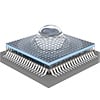
A 3D-printed Janus microchannel heat sink inspired by desert beetles enables ultrafast bubble removal and prevents CPU thermal throttling.
(Nanowerk Spotlight) The Namib desert beetle survives one of Earth’s harshest environments through an elegant trick of surface chemistry. Its shell combines water-attracting bumps with water-repelling troughs, allowing the insect to harvest moisture from fog and use evaporation to cool itself under the scorching sun. A team of researchers has now translated the beetle’s strategy into a cooling system for computer processors, addressing one of the most pressing constraints in modern electronics: heat.
As processors grow more powerful, they generate more heat. NVIDIA’s flagship graphics card, the 5090D, packs 750 mm² of silicon that produces up to 575 W of power, yielding a heat flux of 76.7 W cm⁻². This approaches the practical limits of conventional cooling systems. Air-cooled heat sinks struggle to keep pace. Liquid cooling helps, but traditional designs face a fundamental problem rooted in the physics of boiling.
When liquid contacts a hot surface, it forms bubbles of vapor. If these bubbles depart quickly, they carry heat away efficiently through a process called nucleate boiling. But if they linger and merge, they form an insulating vapor film that blocks heat transfer and can cause catastrophic overheating. The transition from helpful bubble formation to harmful vapor blanketing occurs at a threshold called the critical heat flux, or CHF. Pushing beyond this limit causes cooling to fail.
Previous approaches to raising the CHF have included nanofluids, complex microchannel geometries, electric fields, vibrations, and magnetic forces. Each brings drawbacks. Nanofluids are expensive and degrade over time. Intricate channel structures are difficult to manufacture. External fields consume additional energy. Surface treatments offer another path. Hydrophobic surfaces, which repel water, promote bubble formation but encourage vapor films at high heat loads. Hydrophilic surfaces, which attract water, help bubbles detach but suppress the nucleation needed for efficient boiling. Neither approach alone achieves both goals.
The device uses 3D printing to create microchannels topped with a porous membrane that is superhydrophobic on its upper surface and hydrophilic on its lower surface. This asymmetric arrangement, called a Janus structure after the two-faced Roman god, creates a pressure gradient that drives bubbles upward through the membrane within milliseconds, preventing vapor film formation while maintaining continuous liquid contact with the hot surface.
Biomimetic microchannels for efficient two-phase boiling heat transfer of chips with its excellent heat dissipation performance. a) The structures
on the surface of Namib desert beetle allows them to survive in a high-temperature desert. b) A unique type of biomimetic microchannel for active gas-liquid separation during boiling process. The surface of Janus membrane above the microchannels exhibits hydrophilicity with a CA of 151°. c) Temperature of CPU with bionic microchannel heat sink and a traditional one applied for cooling of CPU. (Image: Reproduced with permission from Wiley-VCH Verlag) (click on image to enlarge)
The physics relies on Laplace pressure, which arises from surface tension at curved interfaces. A bubble’s internal pressure depends on its curvature. When a bubble sits between a hydrophilic surface below and a superhydrophobic surface above, the difference in how water interacts with each surface creates a pressure imbalance that pushes the bubble upward through microscopic pores in the membrane.
For a bubble approximately 450 μm in diameter, this pressure difference reaches about 129 Pa, generating a force of roughly 2.05 × 10⁻⁵ N. The researchers confirmed that surface tension dominates the bubble dynamics by calculating the Bond number, which compares gravitational to surface tension forces (approximately 10⁻³), and the Weber number, which compares inertial to surface tension forces (approximately 10⁻²). Both values indicate that gravity and inertia play negligible roles.
The team fabricated the heat sink using projection micro-stereolithography, a 3D printing technique that cures photosensitive resin layer by layer with micrometer precision. After printing, they coated the upper membrane surface with nano-silica particles to achieve superhydrophobicity, with a contact angle of 152 ± 3°. The lower channels remained hydrophilic. Scanning electron microscopy revealed controlled surface roughness that enhances bubble nucleation by providing more active sites where vapor can form.
High-speed imaging revealed the mechanism in action. Bubbles generated on the hydrophilic side traversed the Janus membrane within 5 ms and accumulated on the superhydrophobic surface above. When the membrane was inverted, bubbles remained trapped on the superhydrophobic side, confirming directional transport. The average bubble departure frequency reached approximately 200 Hz at a heat flux of about 50 W cm⁻², indicating rapid cycling that maximizes heat removal.
The researchers systematically tested how different structural parameters affected performance. Rectangular micropores outperformed circular, triangular, pentagonal, and hexagonal shapes, sustaining a peak heat flux of 105 W cm⁻² due to their higher porosity of 0.74. Grid spacing mattered too: pitches below 450 μm caused growing bubbles to contact opposing struts, creating downward capillary forces that hindered bubble transport. Channel height proved critical as well. Heights exceeding 500 μm allowed bubbles to remain attached longer, reducing efficiency. The rectangular micropore design achieved a boiling heat transfer coefficient of approximately 6500 W m⁻² K⁻¹.
Compared to traditional microchannel heat sinks without the Janus treatment, the new design achieved up to 125% higher critical heat flux. Durability testing over fifteen days of continuous boiling showed no significant degradation of the superhydrophobic coating.
The team then integrated their heat sink into a commercial CPU cooling system. A 1 mm copper plate bonded to the Janus membrane sat atop the processor, separated by thermal paste with a conductivity of 12.8 W m⁻¹ K⁻¹. Coolant flowed through the microchannels while bubbles passed upward through the membrane into a collection reservoir.
Under full computational load, the Janus-cooled CPU maintained its maximum clock frequency of 3.19 GHz without thermal throttling. A comparison system using a traditional untreated membrane with a 70° contact angle reached the critical temperature threshold of 105 °C within 10 s, triggering frequency reduction to 2.7 GHz. The Janus system required only 3.2 W of pumping power, compared to approximately 10 W for a conventional liquid cooling setup with pump and fan, representing a 68% reduction in cooling energy consumption.
Benchmark tests confirmed practical benefits. Computational performance scores doubled compared to the traditional system. Gaming frame rates improved by an average of 105%. Long-term cycling tests showed no frequency throttling, validating stable operation.
By embedding asymmetric wettability into a manufacturable structure, the researchers created a cooling system that handles heat fluxes beyond the reach of standard designs while consuming less energy. The approach could extend to other high-heat applications, including data centers, electric vehicles, and aerospace systems, where thermal management constrains performance.
For authors and communications departmentsclick to open
Lay summary
Prefilled posts
Nanowerk Newsletter
Get our Nanotechnology Spotlight updates to your inbox!
Thank you!
You have successfully joined our subscriber list.
Become a Spotlight guest author! Join our large and growing group of guest contributors. Have you just published a scientific paper or have other exciting developments to share with the nanotechnology community? Here is how to publish on nanowerk.com.