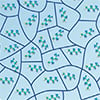
A spider-web Janus membrane combines directional moisture transport, heat modulation, triboelectric power generation and strong antibacterial activity in a flexible platform for next-generation wearable materials.
(Nanowerk Spotlight) Research on advanced membrane materials has produced a range of approaches for controlling water, vapor, heat, and contaminants in thin polymer structures used in wearable systems.
Early waterproof breathable films were based on microporous fluoropolymers that blocked liquid water by using pores smaller than typical droplets while still allowing water vapor to move outward. These films improved comfort compared with nonporous barriers but offered limited directional control over water transport and provided no active functions.
Subsequent work introduced Janus membranes with asymmetric wettability. One hydrophilic side absorbed sweat and one hydrophobic side prevented external liquid entry, creating one-way liquid movement. Other research showed that mechanical contact between materials could generate electrical power through the triboelectric effect, and that metal organic frameworks and metal nanoparticles could release ions capable of damaging bacterial membranes.
These developments expanded the possibilities for wearable materials but left open the problem of combining directional moisture management, energy harvesting, and antibacterial function in a single membrane that remains flexible and durable.
The membrane aims to regulate moisture and heat, generate electrical output from motion, and enhance antibacterial activity when an internal electric field is present. Its fabrication method uses synchronous electrospinning and electrospraying, which the authors describe as compatible with roll-to-roll processing.
a) Schematic diagram of 2D polymer nanonet preparation; b) Working principle of 2D polymer nanonets as waterproof breathable devices; c) Schematic diagram of jet injection and droplet injection at the top of the Tyler cone; d) Schematic diagram of the force mechanism on spinning droplets and their deformation process during electrostatic jetting under an electric field; e) Schematic illustration of the self-assembly process of 2D nanonets based on phase separation of charged droplets. (Image: Reproduced with permission from Wiley-VCH Verlag) (click on image to enlarge)
The structure relies on two polymers with contrasting behavior. The outward layer is based on PVDF HFP, a fluorinated polymer that stores electrical charge and resists wetting. The inward layer uses PA6, a nylon type polymer that absorbs water and bends without damage. This pairing creates a natural driving force that moves liquid and vapor away from the skin.
During fabrication, the electric field produces both fibers and very fine strands that form a secondary web. This gives the membrane a two-level structure. Additives in the PVDF HFP layer encourage this web to form and also introduce zinc-based particles that later contribute to antibacterial action. The PA6 layer incorporates silver nanoparticles formed during spinning, which supply an additional antibacterial pathway. These choices increase surface area, improve fluid movement, and enable later electrical activity.
The finished membrane is light, porous, and flexible. It tolerates repeated bending without structural loss and has higher thermal stability than either polymer alone. Its pore structure supports one way moisture transport. Water placed on the hydrophobic side stays on the surface at first, then gradually passes through to the hydrophilic side. Water placed on the hydrophilic side spreads across the surface but does not migrate back toward the hydrophobic layer. Drying tests show that the membrane removes moisture faster than cotton, wool, silk, polyurethane, or polytetrafluoroethylene-based films. A water vapor transmission rate of 2.87 kg m⁻² d⁻¹ reflects this enhanced behavior.
Thermal management is built into the asymmetric structure. The PA6 side warms efficiently under light, and the PVDF HFP side emits heat well. Under simulated sunlight, the two sides differ in temperature by 7.4 °C. This contrast indicates that the membrane can regulate heat flow passively and may support both warming and cooling functions in wearable applications.
The membrane also functions as a triboelectric generator when in contact with skin. Repeated contact and separation between the hydrophobic surface and the skin produces electrical pulses. With the chosen formulation, the membrane reaches an open circuit voltage of 177.5 V and remains stable across a range of motion rates and temperatures. It can charge small capacitors to useful voltages within a short time.
Because the electrical pulses reflect how the membrane is tapped or pressed, the system can transmit simple communication patterns such as Morse code without external power.
Antibacterial activity arises from both chemical components and the electric field generated during operation. Zinc and silver ions interact with bacterial membranes, and the alternating electric field increases this effect. Tests with Escherichia coli, Staphylococcus aureus, and methicillin resistant S. aureus show limited inhibition when the membrane is inactive. When operating as a triboelectric generator, it achieves nearly complete inactivation of all three species. Microscopy shows severe deformation and rupture of bacterial membranes under these conditions. The antibacterial effect remains stable after mechanical bending, washing, and exposure to artificial sweat.
Computer simulations provide additional insight into how the membrane accelerates drying when powered. In a model of a salt solution similar to sweat, an applied electric field increases evaporation because it disrupts the arrangement of water molecules at the surface. This effect aligns with experimental measurements showing that moisture transport increases by about twenty percent when the membrane is electrically active.
The study demonstrates that a single membrane can combine directional moisture transport, thermal modulation, antibacterial function, and triboelectric energy harvesting. Its stability and compatibility with continuous fabrication methods position it as a material platform with potential to support wearable systems that manage heat and moisture while producing their own electrical output.
For authors and communications departmentsclick to open
Lay summary
Prefilled posts
ORCID information
Ning Wang (University of Science and Technology Beijing)
, 0000-0002-7863-8683 corresponding author
Nanowerk Newsletter
Get our Nanotechnology Spotlight updates to your inbox!
Thank you!
You have successfully joined our subscriber list.
Become a Spotlight guest author! Join our large and growing group of guest contributors. Have you just published a scientific paper or have other exciting developments to share with the nanotechnology community? Here is how to publish on nanowerk.com.