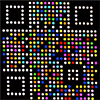
Microdroplet arrays store and conceal digital data through droplet composition, enabling reversible encoding, multi-layer QR patterns, error correction, and time-controlled messages using living cells.
(Nanowerk Spotlight) Most scientific tools treat liquids as a means to an end rather than a destination. A solution mixes chemicals to trigger a reaction. A cell culture grows to measure a fluorescent output. A droplet transfers material between procedures. Liquids flow, blend, and evaporate. Molecules spread until concentrations equalize, and neighboring droplets can merge and erase their distinctions.
These traits make liquids valuable for chemistry and biology, but difficult to use as stable information units. To avoid losing patterns, laboratories separate liquids with rigid structures. Multiwell plates, microchannels, and pipettes keep samples apart, and the real information lives outside the liquid in instrument files and spreadsheets.
This mindset influences how scientists work with advanced liquid systems. Droplet microfluidics produces thousands of miniature reactors, but their positions are hard to control or reference. High-resolution printers deposit nanoliter volumes, yet they typically convert liquids into solids that keep their shape. A droplet becomes a temporary phase, useful only until the data is captured somewhere else. The idea that liquids could serve as persistent information storage has not been widely implemented.
A study in Advanced Materials (“Liquid‐in‐Liquid Prints: High‐Density Biochemically Encoded Information Preserved in Microdroplet Arrays”) by a team from ETH Zurich proposes a system designed to change this. The researchers developed liquid-in-liquid prints (LiL prints), that treat droplets as data pixels. They arrange thousands of tiny water droplets on patterned surfaces submerged in oil. Each droplet carries a specific biochemical composition. They show that these droplets can encode digital content, be read reliably, survive transitions into solid form, and express messages over time through biological growth.
Pipeline for biochemically printing digital information in liquid-in-liquid (LiL) prints: a microdroplet array technology. a) Schematic showing the conversion of different information representations to biochemical droplet composition, here expanded for image printing. b) Droplets in oil are formed on a wettability patterned surface using a 5-channel pressure-controlled PDMS printhead. The composition is set at the point of droplet generation by the pressure ratio of up to 5 component channels (P1–Pn) in the printhead, here shown as a composite droplet color. c) From top to bottom, an example of biochemical patterning resolution in a LiL print reconstruction of the Mona Lisa by Leonardo Da Vinci (scale bar = 1 mm). LiL prints occupy the dimensions of a glass slide, right shows surface droplet morphology (scale bar = 1 mm). Printed via microdroplet arrays by stream shearing (MASS) on a 56-dpi surface. Here, the image color is represented with differentiable fluorescent dyes accordingly, P1-Red–Dextran Alexa Fluor 647, P2-Green–fluorescein and P3-Blue–Dextran Alexa Fluor 405, P4–Black–DI water.Mona Lisa by Leonardo da Vinci, (≈1503–1506; public domain image via Wikimedia Commons, courtesy of the Louvre Museum) was digitally processed and experimentally reproduced in a microdroplet array. The face of Mona Lisa was further converted into a binary pattern and reproduced in a microdroplet array. (Image: Reproduced from DOI:10.1002/adma.202516338, CC BY) (click on image to enlarge)
The researchers built the system around surface anchoring. They fabricated glass slides with circular hydrophilic spots surrounded by hydrophobic background. Each spot measures 250 µm in diameter and sits at a pitch of 450 µm. A single droplet of about 3 nL anchors to each spot like a pixel in a grid. They immerse the entire slide in hydrofluoroether oil to prevent evaporation and keep droplets from merging.
To print the droplets, the team designed a microfluidic printhead made from polydimethylsiloxane. Up to five aqueous solutions enter the printhead through separate inlets, each controlled by a programmable pressure regulator. The channels converge into a single outlet measuring 50 µm × 50 µm × 700 µm. Their software synchronizes inlet pressures with x-y-z movement of the slide. By adjusting how much of each component flows into the outlet, the researchers determine the droplet’s chemical identity at the moment of deposition.
The scientists used two printing strategies. In a stop-on-spots mode, they move the printhead to each location, dispense one droplet, and move to the next. It is slower but highly accurate. In a continuous stream-shearing mode, they sweep the printhead across the slide while changing composition on the fly. That approach increases speed but introduces small shifts between neighboring droplets.
They tested accuracy by printing a black-and-white image and comparing each droplet to the digital reference. The stop-on-spots method reached about 99.9 % accuracy, while the optimized stream-shearing method reached about 98 %, with drift causing most deviations.
The team then examined stability. They printed a multicolor image using three fluorescent dyes and stored the slide in a sealed humidity-controlled chamber inside a refrigerator. After 7 days, all droplets remained pinned, with only one instance of coalescence caused by debris. Fluorescence declined slightly in sulforhodamine B and remained stable for dextran Alexa Fluor 488 and dextran Alexa Fluor 647. Blank spots stayed dark, indicating negligible cross-contamination. Under these conditions, the encoded patterns persisted.
Information density comes from composition. If a droplet uses Cₙ components and each component has L concentration levels, the droplet can encode L^{Cₙ} states. With four components at two levels, each droplet holds four bits. With four components at four levels, each droplet holds one byte. The team identified each level by imaging the droplets in four fluorescence channels and assigning the intensity to its closest reference.
To demonstrate stacked encoding, the researchers printed a 25 × 25 array where each of the four fluorescent components carried a separate QR code. The combined image could not be scanned. When they isolated the fluorescence channels, each QR code became legible. They effectively stored four independent codes in the space normally occupied by one.
Droplets also can hide information through phase change. After printing, the autors let the hydrofluoroether oil evaporate, followed by water. Solutes crystallized on the hydrophilic spots. In this solid form, fluorescence vanished and the encoded patterns could not be read. When they reprinted deionized water, the crystals dissolved and the original droplet compositions reappeared. The information recovered without redesigning the chemistry.
The researchers pushed the platform to higher density. They encoded ASCII byte values using four components and four concentration levels, printing a 10 × 5 block spelling “helloworld.” The fluorescence measurements clustered cleanly into their intended levels, and decoding reproduced the correct string. They cycled the same droplets between liquid and crystallized states.
The first three cycles maintained perfect recovery. Later cycles produced small errors, mostly where fibers or debris interfered. A separate region that they crystallized once and stored at −20 °C for 7 days decoded accurately after rehydration.
They also demonstrated error-correctable word encoding. They selected one hundred words from a public domain text and assigned each unique word to a droplet composition using six or eight concentration levels per component. They printed the words in a 10 × 10 grid and surrounded them with checksum droplets encoding row, column, and diagonal sums. With six levels, a printing accuracy above 99.5 % yielded about 89 % direct recovery and about 99 % recovery after automated correction. With eight levels, multi-component shifts and two-level deviations became more common and harder to repair, making performance dependent on word distribution.
Finally, the researchers used living cells to program when information appears. They printed droplets containing bacteria that express green fluorescent protein. One condition provided nutrient medium. The other combined medium with a sub-minimal inhibitory concentration of the bacteriostatic drug chloramphenicol.
Both droplet types began at the same optical density. Without antibiotic, fluorescence showed a lag of about 1.5 hours, then rose rapidly and plateaued near 8 hours. With antibiotic, the lag extended to about 4 hours and plateaued near 15 hours. When arranged in a QR pattern, these growth curves produced a window from about 3.3 hours to about 8 hours when the QR code could be scanned. After about 14 hours, fluorescence levels converged and the message faded. The timing came from biological kinetics, not external triggers.
This work treats droplets as compositional data units that can be printed, stored, read, and reconfigured. Instead of isolating liquids in wells, it organizes thousands of nanoliter droplets on a single surface. The platform supports reversible phase changes, layered codes, error-correctable schemes, and time-dependent messages. It shows that liquid droplets can function as stable, programmable media for chemical and biological information.
For authors and communications departmentsclick to open
Lay summary
Prefilled posts
Nanowerk Newsletter
Get our Nanotechnology Spotlight updates to your inbox!
Thank you!
You have successfully joined our subscriber list.
Become a Spotlight guest author! Join our large and growing group of guest contributors. Have you just published a scientific paper or have other exciting developments to share with the nanotechnology community? Here is how to publish on nanowerk.com.