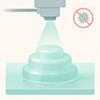
A new 3D printing method uses light to form hydrogels without free radicals, enabling safer biofabrication with fine detail and compatibility for sensitive materials like proteins and soft tissues.
(Nanowerk Spotlight) The light-driven chemistry behind modern 3D printing is fast, efficient, and precise. It works by turning liquid resins into solid structures using patterned ultraviolet light, building objects one layer at a time. This method, known as digital light processing or DLP, is widely used in fields where structural control is essential, including microfluidics, optical components, and soft robotics.
Its appeal lies in its resolution, scalability, and compatibility with automated design systems. But when the material being printed needs to function in a biological environment, DLP reveals a fundamental limitation.
The issue is chemical. Nearly all DLP systems rely on ultraviolet light to generate free radicals, which are short-lived but highly reactive molecules. These radicals initiate polymerization by forming new covalent bonds between monomer units, transforming liquid resin into solid networks.
While effective, this process is chemically aggressive. Free radicals interact unpredictably with many biological and synthetic components. They can damage proteins, degrade fluorescent dyes, destabilize sensitive linkers, and interfere with chemical groups that might otherwise be used for precise modification. In hydrogel systems where water is abundant and embedded molecules are often fragile, these reactions introduce risks that are difficult to eliminate.
Workarounds have been proposed. Chemists have experimented with light-controlled reactions that do not involve radicals, including oxime formation, hydrazone ligation, and various strain-promoted cycloadditions. Some of these reactions are highly selective, but most are too slow to be compatible with layer-by-layer printing. Others require solvents or catalysts that limit their use in aqueous or bioactive environments. As a result, there is still no broadly applicable method for DLP-based hydrogel printing that avoids radicals while maintaining resolution, speed, and chemical versatility.
The method is based on a light-activated chemical sequence that begins with the uncaging of a protected cyclopentadiene group. Once released by ultraviolet light, this molecule undergoes a Diels–Alder reaction with maleimide groups in the resin, forming a stable polymer network. The reaction is fast, selective, and does not involve radicals at any stage. This makes the system compatible with sensitive molecules and suitable for post-print functionalization.
The researchers demonstrate that this chemistry supports high-resolution printing, tunable mechanical properties, and spatially controlled chemical modification after fabrication.
Chemical process involved in these on-demand cleavages of a general CPD–NBD adduct under light irradiation to produce Cp and subsequent conjugation with maleimide (Mal). (Image: Reprinted with permission by Wiley-VCH Verlag)
The resin system is composed of two components. One is a polyethylene glycol (PEG) polymer carrying caged cyclopentadiene groups in the form of cyclopentadienone–norbornadiene (CPD–NBD) adducts. These units remain inert until exposed to light. Upon irradiation at 365 nanometers, the cage breaks through a retro-Diels–Alder reaction, releasing carbon monoxide and generating active cyclopentadiene. This reactive molecule then combines with maleimide groups on the second PEG-based polymer, forming a covalent bond. The entire process occurs in water and is initiated only by light exposure.
The gelation is rapid. Under typical DLP printing conditions, the resin forms a hydrogel within 30 seconds. Rheological measurements confirmed that this transition is triggered only by light and does not proceed in the dark. The reaction rate can be tuned by adjusting light intensity, polymer concentration, and exposure time. Higher concentrations of polymer lead to stiffer gels. Light intensity controls the speed of the curing process, with higher intensities producing faster network formation. This responsiveness makes the system compatible with layer-by-layer printing.
The researchers tested the mechanical properties by varying polymer content from 5 to 20 percent. The resulting hydrogels exhibited elastic moduli ranging from 0.5 to 6.5 kilopascals. This range allows the printed materials to match the mechanical characteristics of various soft tissues. Gelation kinetics were assessed using photo-rheometry, and the system reached full gelation within two minutes. A control experiment with a radical scavenger confirmed that network formation did not involve radical intermediates.
The authors then evaluated the system’s ability to support three-dimensional printing. Using a custom DLP printer, they fabricated structures from the DA-resin that included fine features, hollow geometries, and complex lattice designs. To control vertical resolution, they added tartrazine, a photoabsorber, to limit light penetration depth. Objects were printed in layers with 50 to 100 seconds of exposure per layer, depending on the resin formulation. The structures retained their shape after swelling in water, and printed features showed dimensional accuracy within 90 percent of their design.
One of the key strengths of the system is its capacity for post-functionalization. Because not all CPD–NBD groups are uncaged during initial printing, the remaining sites can be selectively activated after fabrication. The researchers demonstrated this by irradiating printed objects with light and then immersing them in a solution containing maleimide-linked fluorescent dyes. This secondary reaction produced spatially controlled labeling, which was confirmed by fluorescence microscopy. The ability to modify chemical functionality after printing adds flexibility and enables the incorporation of biological or sensing elements at defined locations.
A final demonstration involved printing a gyroid hydrogel and selectively functionalizing it with a fluorescent dye throughout the structure. The reaction proceeded uniformly through the volume, showing that the uncaging event could be achieved at depth. This confirms that the system supports volumetric chemical activation and is not limited to surface modification.
The chemistry underlying this method is modular and orthogonal. It does not interfere with other functional groups commonly used in biological systems. Because it avoids radicals, it is also compatible with fragile proteins and signaling molecules. Although the current system uses ultraviolet light, which has limited penetration and may affect biological components under prolonged exposure, the authors note that future versions may use red-shifted light to reduce energy input while maintaining reactivity. They also acknowledge that the uncaging step produces trace carbon monoxide, a byproduct that should be evaluated in biological settings.
This study introduces a technically complete and operationally feasible strategy for radical-free 3D printing of hydrogels. It avoids the complications of free-radical polymerization while preserving the resolution, curing speed, and adaptability required for high-quality fabrication. The work supports a range of applications in soft materials, tissue scaffolds, and programmable hydrogels. It also establishes a framework for combining spatially controlled photochemistry with structurally defined materials.
By developing a resin that is chemically selective, biologically compatible, and responsive to light, Kaneko and colleagues provide a route toward safer and more versatile methods for building soft matter systems with embedded functionality. Their contribution lies not only in the chemistry, but in demonstrating how that chemistry can be applied using standard tools to produce practical and adaptable materials.
If this article was useful, support our independent nanotechnology reporting with any amount.
Your contribution funds the next explainer and keeps Nanowerk open for everyone.
For authors and communications departmentsclick to open
Lay summary
Prefilled posts
ORCID information
Javier Read de Alaniz (University of California, Santa Barbara,)
, 0000-0003-2770-9477 corresponding author
Sophia J. Bailey (University of California, Santa Barbara,)
, 0000-0001-6477-8936 corresponding author
Nanowerk Newsletter
Get our Nanotechnology Spotlight updates to your inbox!
Thank you!
You have successfully joined our subscriber list.
Become a Spotlight guest author! Join our large and growing group of guest contributors. Have you just published a scientific paper or have other exciting developments to share with the nanotechnology community? Here is how to publish on nanowerk.com.