What happens to soft matter when gravity disappears? To answer this, physicists launched a fluid dynamics experiment on a sounding rocket. The suborbital rocket reached an altitude of 267 km before falling back to Earth, providing six minutes of weightlessness.
(Nanowerk News) In these six minutes, the researchers 3D-printed large droplets of a soft material similar to the inks used for bioprinting – a developing technology that shows huge potential for regenerative and personalised medicine, tissue engineering and cosmetics. Bioprinting involves 3D-printing a mix of cells and bio-inks or bio-materials in a desired shape, often to construct living tissues.
The experiment was called COLORS (COmplex fluids in LOw gravity: directly observing Residual Stresses). Using a special optical set-up, the researchers could see where the printed material experienced internal stresses (forces) as the droplets spread and merged. Stressed regions stand out as bright colours in the experiment. Investigating how and where these stresses emerge is important because they can get frozen in a material as it solidifies, creating weak points where 3D-printed objects are most likely to break.
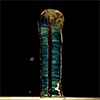
A 3D-printed soft material (micellar solution) used in the COLORS experiment. The colours in the video show where internal stresses (forces) are present in the material. The video shown here is taken from the preliminary experiment conducted in a drop tower to test the concept before the sounding rocket flight. Left is a side view, right is a top view. (Image: Olfa D’Angelo)
This experiment was impossible to do on Earth’s surface, where the pull of gravity is too strong and makes these weak – yet very important – forces hard to detect. “By temporarily removing gravity, the suborbital flight let us directly observe the stresses inside the fluid, while maintaining the other conditions relevant for advanced 3D printing and bioprinting,” says dr. Olfa D’Angelo, who led the research team.
She adds: “The results from COLORS will help us build more reliable models of fluid deposition and move closer to a true digital twin for additive manufacturing of soft materials. This is essential for increasing the reliability and reproducibility of 3D printed objects, including in demanding applications such as bioprinting, both in space and here on Earth.”
Currently, the research team is analysing the footage from the COLORS experiment, and expects to publish the results in the coming year. The next step is to continue developing and refining the optical method used in COLORS, towards the goal of understanding how gravity influences soft material processing.