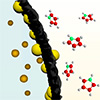
Two nonconductive liquids produce a conductive film where they meet, enabling 3D-printed all-liquid wires that obey Ohm’s law and repair themselves after being cut.
(Nanowerk Spotlight) What if some electronic devices could be made entirely of liquids? Such devices could deform without cracking, heal after damage, and be reshaped on demand. These properties would make them ideal for soft robotics, wearable health monitors, and biomedical implants. Reaching that goal requires a fundamental building block: an all-liquid wire that conducts current and holds a defined shape yet remains fluid enough to reconfigure when needed.
So far, that building block has been elusive. Previous attempts relied on intrinsically conductive liquids, such as liquid metal composites for stretchable circuits, conductive polymer solutions, or ionic liquids, stabilized at the boundary between two immiscible fluids. A jammed layer of nanoparticles or polymers at that boundary can lock a liquid filament into a fixed shape, as demonstrated in work on 3D-printable magnetic liquid devices.
But the selection of suitable conductive species is small, mechanical stiffness has been limited, and printing parameters must be tightly controlled to prevent thin filaments from breaking into droplets through capillary instability. Every approach so far has required starting materials that already conduct electricity.
A study published in Advanced Science (“Solid‐Like yet Reconfigurable 3D‐Printed Liquid Tubular Wires From Nonconductive Molecules”) discards that requirement, with a result that seems to contradict basic logic: two liquids that cannot conduct electricity on their own produce a conductive material the moment they touch. Neither ingredient carries current in isolation. Conductivity is not a property of either starting liquid but something entirely new that emerges at their shared boundary.
Schematic of the formation process of the PPy film at the water–oil interface by interfacial redox reactions. (Image: Adapted from DOI:10.1002/advs.202524287, CC BY)
Here is how it works. An aqueous solution of gold-containing ions (tetrachloroaurate, AuCl₄⁻) is extruded through a needle into an organic bath containing dissolved pyrrole monomers, small ring-shaped molecules that do not conduct. At the liquid-liquid boundary, a redox reaction oxidizes the pyrrole into polypyrrole, a well-known conductive polymer, while reducing the gold ions to metallic nanoparticles roughly 80 nm across. The result is a robust conductive skin of polypyrrole embedded with gold nanoparticles, encasing a nonconductive liquid interior. The team calls these structures liquid tubular wires.
Surface analysis confirmed the film’s composition. X-ray photoelectron spectroscopy detected the chemical signatures of polypyrrole and metallic gold, indicating that the redox reaction had gone nearly to completion. Scanning electron microscopy revealed fibrils at the interface that grow and interconnect into a continuous polymer network, with gold nanospheres scattered throughout.
The film forms best under mildly acidic conditions, reaching 98 % surface coverage at pH 4 within one hour. Higher reactant concentrations promoted stiffer films. At the upper end of the tested range, the film could support the weight of the underlying organic phase when its container was inverted and even recovered its integrity after being punctured with a needle.
Under direct current, the interfacial layer sustained a stable current of approximately 40 µA, orders of magnitude above what either precursor solution carried alone. Impedance spectroscopy confirmed that the polypyrrole film dramatically lowered the charge transfer resistance at the liquid-liquid boundary, creating an efficient electron-transport pathway from nonconductive starting materials.
Printing these wires posed a specific challenge. Neither pyrrole nor the gold ions lower the interfacial tension between water and oil, which remained at roughly 28 mN m⁻¹, well above the 20 mN m⁻¹ threshold typical of previous liquid-in-liquid printing systems. The team compensated with high-viscosity silicone oil, fast needle movement, and a high flow rate, collectively generating enough inertial force to stabilize the filament until the stiff polypyrrole film locked it into shape.
The printed wires obeyed Ohm’s law: current scaled linearly with voltage across wires of varying diameter and length, and resistance followed the classical dependence on conductor geometry. The liquid core, however, gives these wires a capability that solid conductors lack. A severed wire can be restored by injecting fresh gold precursor solution into the gap. Over ten successive cut-and-repair cycles, resistance hovered around 90 kΩ for the first eight repairs and rose only modestly afterward.
Several demonstrations illustrated the wires’ practical potential. Connected to an Arduino board driving a seven-segment display, a liquid tubular wire reliably transmitted the digital sequence “HELLO 2025.” Adding a surfactant to the aqueous phase lowered the interfacial tension further, enabling printing of more complex shapes, including hearts, rhombuses, butterflies, and three-dimensional rings.
The team also printed wires into a curable silicone elastomer and allowed it to harden, producing a proof-of-concept sensor. Its resistance decreased upon bending and increased upon stretching, returning to baseline over repeated cycles. These responsive and repeatable signals point toward applications in wearable sensing.
By decoupling conductivity from the starting materials, this strategy removes a central constraint on all-liquid electronics: dependence on the small number of liquids that already conduct. Because the conductive shell forms through interfacial chemistry, the approach could extend to other monomer-oxidant pairs beyond pyrrole and gold, broadening the design space for adaptive, self-repairing electronic systems.
For authors and communications departmentsclick to open
Lay summary
Prefilled posts
Nanowerk Newsletter
Get our Nanotechnology Spotlight updates to your inbox!
Thank you!
You have successfully joined our subscriber list.
Become a Spotlight guest author! Join our large and growing group of guest contributors. Have you just published a scientific paper or have other exciting developments to share with the nanotechnology community? Here is how to publish on nanowerk.com.